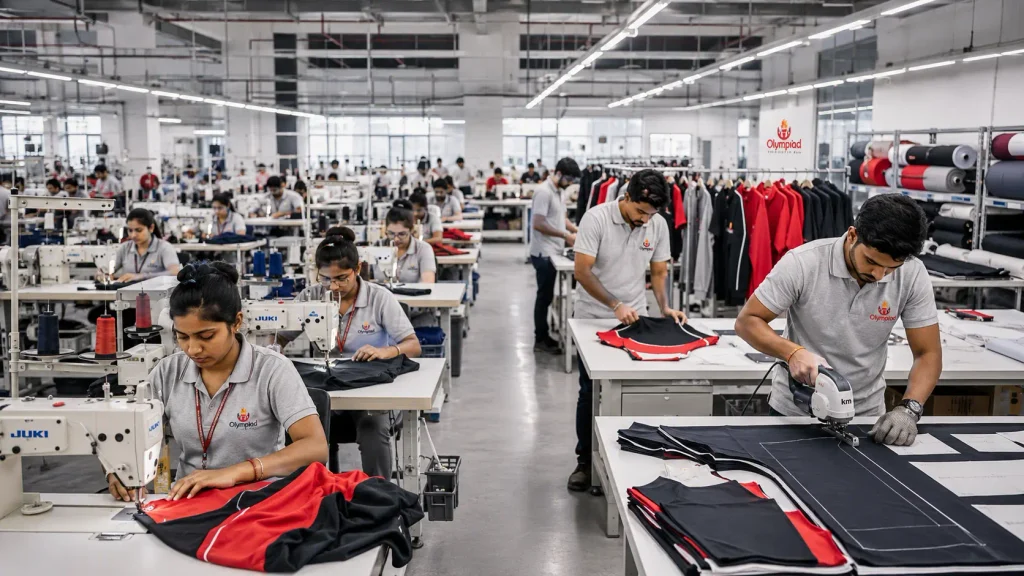
At Olympiad Industries, quality checking is an important part of every production order. Our quality check process starts before cutting and continues until the finished garments are approved for packing and shipment.
Instead of relying only on a final visual check, we inspect the most important areas of the product at different stages. This helps us identify problems early, maintain consistency during bulk production, and ensure that the finished garments match the approved requirements.
Our main quality check process includes:
Fabric Inspection → Color Matching → GSM Checking → Bleed & Washing Test → RFI Checking → Final Inspection
1. Fabric Inspection
Fabric is the foundation of every garment, so our quality control process begins with a detailed fabric inspection before the material enters production.
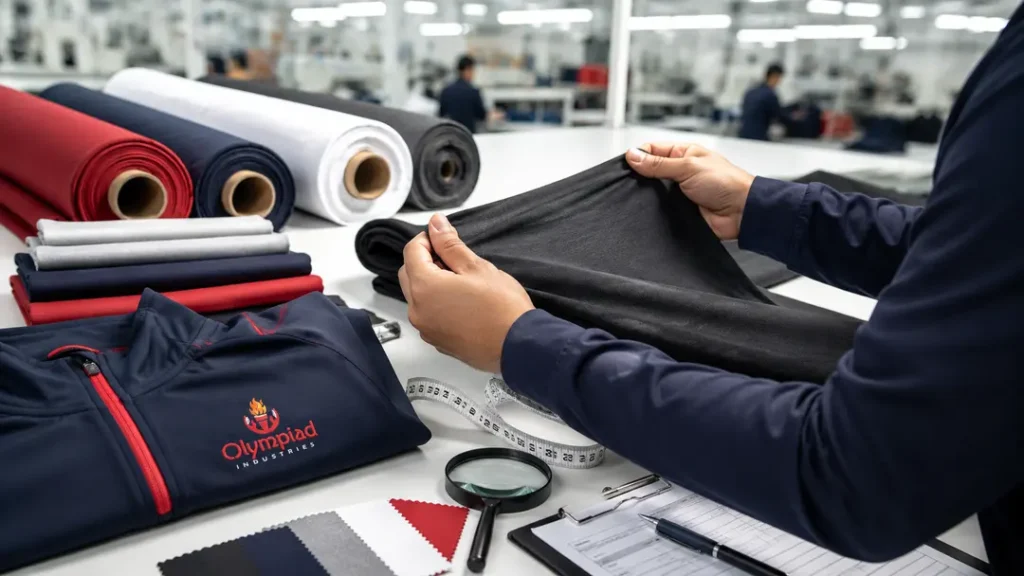
Once the required fabric is received, our quality team checks it to make sure it is suitable for the approved product. The inspection focuses on the overall appearance, construction, consistency, and condition of the fabric.
During fabric inspection, we check for:
- Holes, cuts, or damaged areas
- Knitting or weaving defects
- Oil marks, stains, or dirt
- Uneven fabric surface
- Shade variation
- Lines or visible production marks
- Incorrect fabric width
- Stretch and recovery
- Fabric texture and hand feel
- Any other visible defects
The fabric is also checked to confirm that the correct material has been selected according to the customer’s approved requirements.
For stretch fabrics used in sportswear and activewear, we also pay attention to flexibility and recovery. The fabric should stretch properly and return to its original shape without becoming loose or distorted.
If defective areas are identified, they are marked or separated so they are not used during cutting.
This stage is important because a fabric defect that is missed at the beginning can become part of the finished garment. By identifying these issues before production, we can reduce waste, prevent unnecessary rework, and maintain better consistency throughout the order.
2. Color Matching
Color is one of the most noticeable parts of any custom garment. A small difference in shade can affect the overall appearance of a team uniform, sportswear collection, or private-label product.
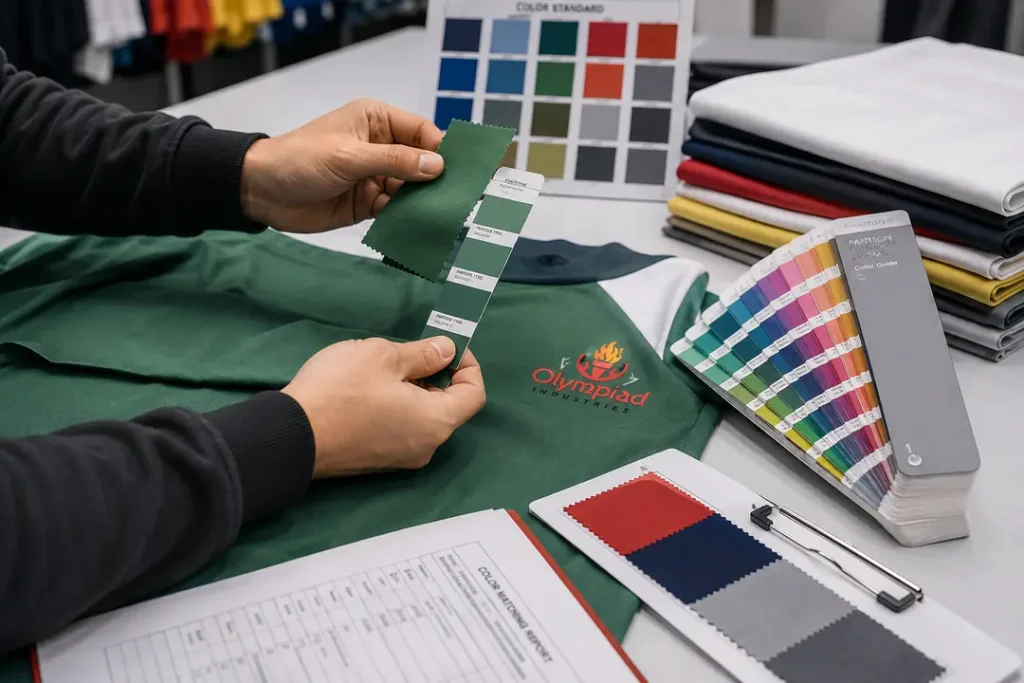
At Olympiad Industries, color matching is carried out according to the customer’s approved reference, artwork, sample, or required color specification.
Before bulk production, our team checks the selected fabric and other visible components to make sure the colors are as close as possible to the approved standard.
Color matching may include:
- Main body fabric
- Sleeves
- Side panels
- Contrast fabric
- Ribbing
- Cuffs
- Collars
- Sublimation colors
- Screen printing colors
- Heat-transfer colors
- Embroidery thread
- Logos
- Labels and trims
We also check fabric from different rolls because two rolls of the same color can sometimes have slight shade differences. Where necessary, matching fabric is grouped together to maintain a consistent appearance within the same order.
For customized sports uniforms, we pay particular attention to the relationship between the garment color and the printed or embroidered design. For example, the color of a team logo, sponsor logo, player number, or graphic should work correctly with the approved base color.
Color checking helps us minimize visible shade differences and maintain a more uniform appearance across bulk production.
3. GSM Checking
GSM stands for Grams per Square Meter and is used to measure the weight of fabric.
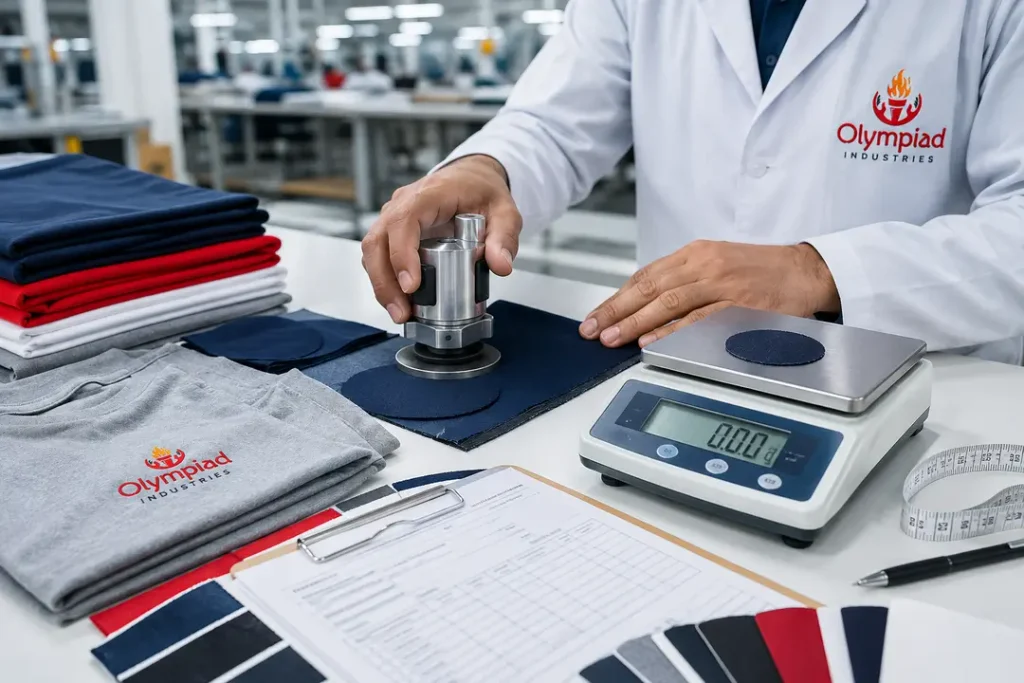
GSM is an important quality factor because it gives a clear indication of whether the fabric being used is suitable for the intended garment.
At Olympiad Industries, fabric GSM is checked before production to confirm that it is within the required or approved range.
Different products require different fabric weights. For example:
- Lightweight sports jerseys may require lower GSM fabric for breathability.
- Training wear may require a medium-weight performance fabric.
- Hoodies and sweatshirts normally require heavier fabric.
- Tracksuits may use different GSM depending on the season and intended use.
- Activewear may require a specific balance between weight, stretch, and support.
During GSM checking, a sample of fabric is taken and measured using the appropriate GSM testing method or equipment.
The result is then compared with the required specification.
GSM can directly affect:
- Fabric thickness
- Garment weight
- Durability
- Breathability
- Comfort
- Opacity
- Drape
- Feel of the garment
- Overall product quality
For example, if the GSM is significantly lower than required, the fabric may feel too light or thin. If it is too high, the garment may feel heavier than expected and may not provide the required level of comfort or breathability.
By checking GSM before production, we can confirm that the correct fabric quality is being used for the product.
4. Bleed & Washing Test
Fabric and garment performance should not only look good before use; it should also remain acceptable after washing.
For this reason, Bleed and Washing Tests are an important part of our quality process, particularly for products with multiple colors, prints, sublimation, or other forms of decoration.
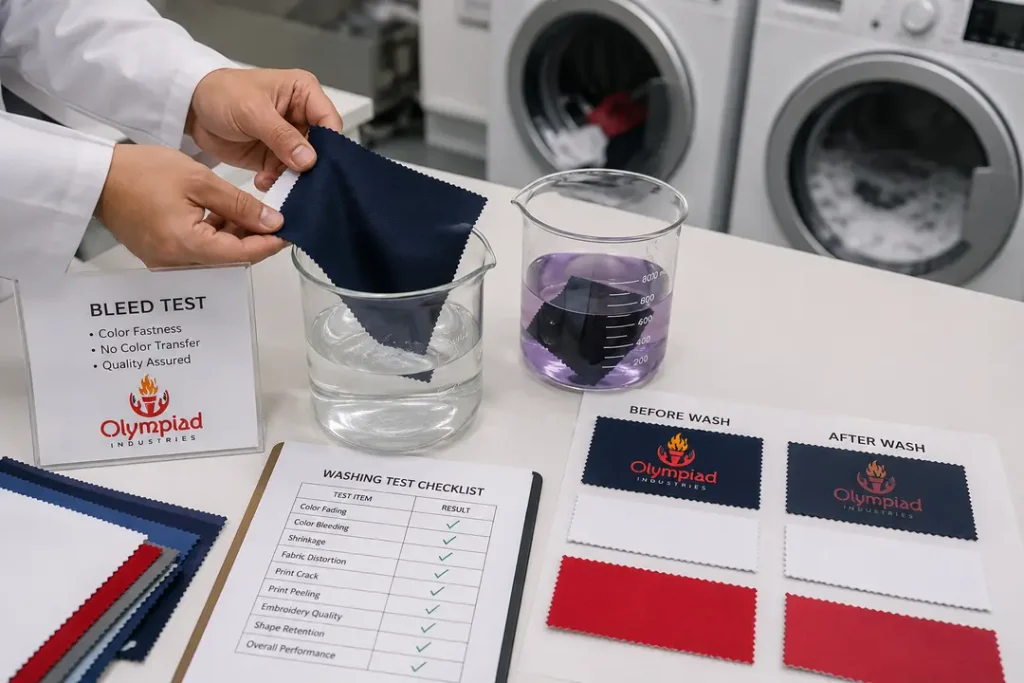
Bleed Test
The bleed test is performed to check whether a fabric color, print, or decoration may transfer onto another part of the garment.
This is particularly important for combinations such as:
- Black and white
- Red and white
- Navy and white
- Dark and light panels
- Bright colors combined with light fabrics
- Multi-color sports uniforms
During the test, the fabric or garment is exposed to controlled conditions that help us evaluate whether the dye or color may migrate or bleed.
Our team checks for:
- Color transfer
- Staining
- Migration into light-colored areas
- Changes in printed graphics
- Color movement between fabric panels
- Unwanted marks after moisture or washing
If a significant bleeding issue is found, the fabric, printing method, or production process may need to be reviewed before bulk production continues.
Washing Test
The washing test is carried out to evaluate how the garment performs after washing.
A sample garment or fabric may be washed according to the suitable care conditions for the product. After washing and drying, our team compares it with its condition before washing.
The washing test checks for:
- Shrinkage
- Color fading
- Color bleeding
- Fabric distortion
- Changes in garment shape
- Twisting
- Seam problems
- Print cracking
- Print peeling
- Transfer lifting
- Embroidery distortion
- Fabric surface changes
Measurements may also be taken before and after washing to determine whether the garment has experienced unacceptable shrinkage or dimensional change.
This process is especially useful for sportswear, activewear, streetwear, hoodies, T-shirts, and private-label garments that are expected to be washed regularly.
The purpose of the test is to help ensure that the garment maintains its appearance, dimensions, and decoration after normal use and washing.
5. RFI Checking
RFI Checking is an important inspection stage carried out when garments reach the required production point and are ready to be reviewed by the quality team before final approval.
During this inspection, the garment is checked against the approved specifications, sample, artwork, size chart, and production details.
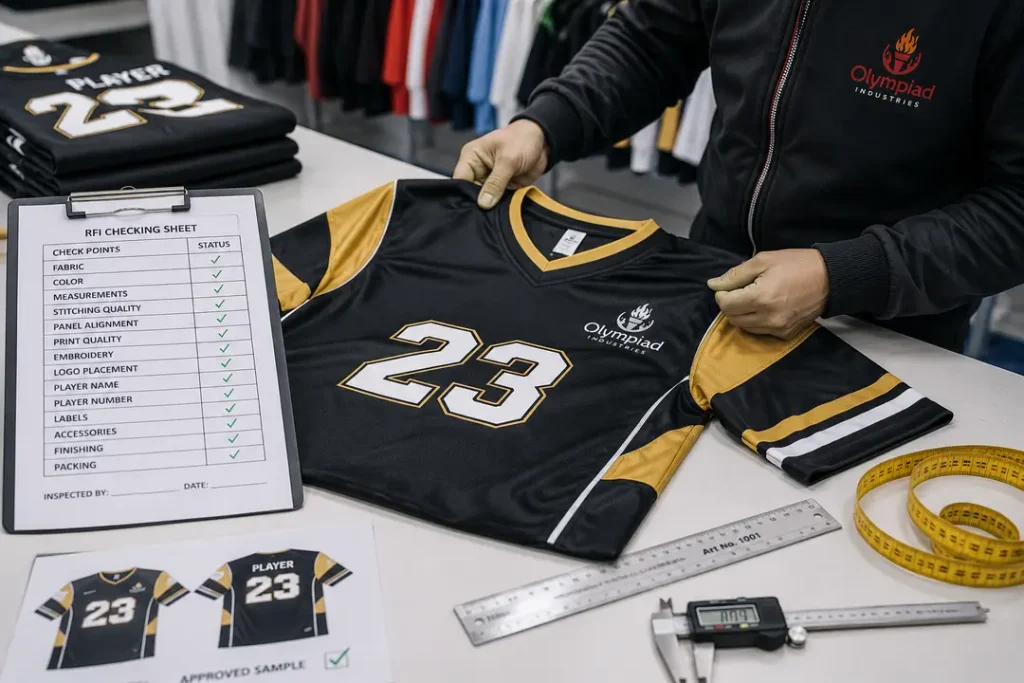
Our team examines both the technical construction and the visual appearance of the product.
RFI checking may include:
Fabric Verification
The quality inspector confirms that the correct fabric has been used and checks for any visible defects that may have appeared during cutting, stitching, or handling.
Measurement Checking
Key garment measurements are checked against the approved size chart.
Depending on the product, this may include:
- Chest
- Body length
- Shoulder
- Sleeve length
- Waist
- Hip
- Inseam
- Outseam
- Leg opening
- Collar
- Cuffs
Measurements are reviewed within the acceptable production tolerance.
Stitching Inspection
The garment construction is carefully inspected for:
- Open seams
- Broken stitches
- Skipped stitches
- Loose stitching
- Uneven seams
- Puckering
- Incorrect panel joining
- Poor finishing
- Loose threads
Important stress areas are given additional attention because strong stitching is especially important in sportswear and active garments.
Artwork & Branding Check
All customization is checked against the approved artwork.
This includes:
- Team logos
- Brand logos
- Sponsor logos
- Player names
- Player numbers
- Embroidery
- Sublimation
- Screen printing
- Heat transfer
- Labels
The quality inspector checks that the design is correct, properly positioned, and consistent with the approved reference.
Accessories Check
Any accessories used in the garment are also inspected.
These may include:
- Zippers
- Buttons
- Snaps
- Drawcords
- Elastic
- Velcro
- Eyelets
- Labels
- Patches
The accessories should be correctly attached and function properly.
If any issue is identified during RFI checking, the affected garment is separated and sent for correction.
After correction, it is checked again before being allowed to move to the final inspection stage.
6. Final Inspection
The Final Inspection is the last major quality-control stage before garments are packed and prepared for shipment.
At this point, production, embellishment, thread trimming, and finishing should already be completed.
The purpose of the final inspection is to review the complete product and confirm that it meets the approved order requirements.
Overall Appearance
The garment is first checked for its general appearance.
The quality team looks for:
- Stains
- Oil marks
- Dirt
- Fabric damage
- Loose threads
- Holes
- Visible stitching problems
- Uneven panels
- Wrinkles or finishing issues
The garment should look clean, balanced, and professionally finished.
Size and Measurement Check
The final garment is checked against the approved size specifications.
This ensures that the garment still remains within the required measurements after stitching, embellishment, and finishing.
Stitching & Construction
Seams and important construction areas are reviewed again to make sure that there are no open seams, broken stitches, loose threads, or other visible workmanship problems.
Printing & Embroidery
All decoration is inspected one final time.
We verify:
- Logo position
- Logo size
- Print quality
- Embroidery quality
- Correct colors
- Player names
- Player numbers
- Sponsor details
- Artwork alignment
For customized team orders, the name, number, and size of each garment are checked carefully to reduce the possibility of mix-ups.
Labels & Accessories
The inspector confirms that the correct labels and accessories are present and properly attached.
This may include:
- Brand label
- Size label
- Care label
- Zippers
- Drawcords
- Buttons
- Patches
- Other custom accessories
Quantity & Size Breakdown
The finished quantity is also checked according to the confirmed purchase order.
Garments may be sorted by:
- Style
- Color
- Size
- Design
- Player name
- Player number
This helps ensure that the correct quantity and breakdown are prepared for packing.
Rework & Re-Inspection
If any garment does not pass final inspection, it is separated from the approved pieces.
Depending on the issue, it may be sent for:
- Restitching
- Cleaning
- Thread trimming
- Printing correction
- Embroidery correction
- Accessory replacement
- Other required rework
After the correction has been completed, the garment is inspected again.
Only products that meet the required quality standard are approved for packing.
Our Quality Check Process
At Olympiad Industries, our quality control system follows a structured quality check process:
Fabric Inspection → Color Matching → GSM Checking → Bleed & Washing Test → RFI Checking → Final Inspection
Each stage has a specific purpose. Fabric inspection helps us identify material defects, color matching maintains visual consistency, GSM checking confirms fabric weight, washing and bleed tests evaluate performance, RFI checking identifies production issues, and final inspection confirms that the finished garments are ready for delivery.
Through these quality-control stages, we aim to maintain consistent fabric quality, accurate customization, reliable construction, proper finishing, and professional presentation across our custom sportswear, activewear, streetwear, teamwear, and private-label production.
At Olympiad Industries, quality is checked throughout the manufacturing process so that every approved product is prepared with attention to detail before it reaches the customer.