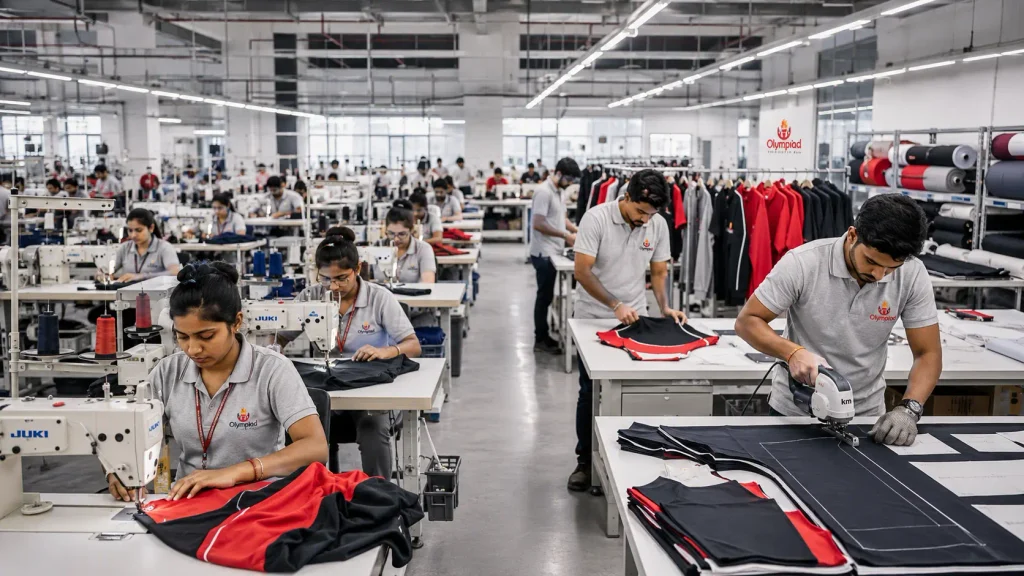
Embellishment is an important stage in sportswear and apparel manufacturing where designs, logos, names, numbers, graphics, and branding elements are applied to a garment. It turns a basic garment into a customized product that represents a team, brand, club, business, event, or individual identity.
At Olympiad, embellishment is carried out according to the approved artwork, colors, dimensions, placement, and production requirements. Different techniques are available depending on the fabric, garment type, design complexity, order quantity, intended use, and desired finish.
Our major embellishment methods include:
- Sublimation Printing
- Embroidery
- Sticker Printing
- Heat Transfer Printing
- Silk Screen Printing
- Vinyl Transfer
- DTF Printing
- Special Effects & Finishes
- Custom Names & Numbers
- Logo & Branding Application
Each method has its own benefits and is selected carefully to provide the right appearance, durability, flexibility, and performance.
Why Embellishment Is Important
Embellishment is more than simply adding a logo to a garment. In custom sportswear and apparel manufacturing, it plays an important role in the overall appearance and identity of the finished product.
Professional embellishment helps to:
- Display team and club identities
- Apply company and sponsor logos
- Add player names and numbers
- Create custom patterns and graphics
- Strengthen brand recognition
- Produce professional retail-ready garments
- Differentiate one collection from another
- Add value to basic apparel
- Create customized private-label products
The right embellishment method must also work properly with the fabric. Sportswear often needs to remain lightweight, breathable, flexible, and comfortable, so printing or embroidery should not negatively affect the performance of the garment.
Sublimation Printing
Sublimation printing is one of the most widely used embellishment techniques for modern sportswear. It is especially suitable for polyester and polyester-rich performance fabrics.
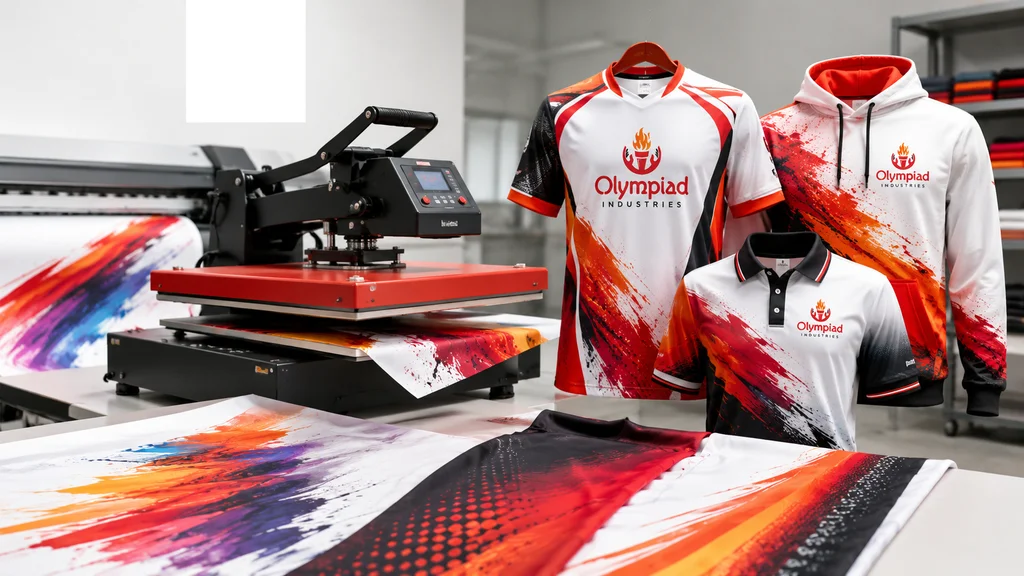
Unlike surface printing methods, sublimation allows the design to become part of the fabric itself.
How Sublimation Printing Works
First, the approved design is digitally prepared according to the garment pattern. This can include:
- Team colors
- Logos
- Player names
- Numbers
- Sponsor logos
- Stripes
- Gradients
- Geometric patterns
- Background graphics
The design is printed onto special sublimation transfer paper using sublimation inks.
The printed paper and polyester fabric are then placed inside a heat press or sublimation machine. Under controlled temperature and pressure, the ink changes into gas and penetrates the fibers of the fabric.
After cooling, the design becomes permanently embedded in the material.
Benefits of Sublimation Printing
Sublimation offers several advantages for sports uniforms.
Unlimited Design Possibilities
Complex graphics, multiple colors, gradients, patterns, names, numbers, and logos can all be incorporated into one complete design.
Lightweight Finish
Because the ink becomes part of the fabric, there is almost no additional layer sitting on the surface.
This helps maintain the natural flexibility and breathability of performance fabric.
Excellent Durability
Sublimated graphics do not normally crack, peel, or flake because they are not applied as a separate surface layer.
Full-Garment Customization
Large areas of the garment can be customized, making sublimation particularly suitable for bold sports uniform designs.
Consistent Branding
Logos, sponsor graphics, player information, and decorative patterns can be positioned accurately according to the approved mockup.
Common Products for Sublimation
Sublimation is commonly used for:
- Ice hockey jerseys
- Soccer uniforms
- Basketball jerseys
- Baseball jerseys
- Cycling jerseys
- Rugby uniforms
- Volleyball uniforms
- Esports jerseys
- Running shirts
- Training shirts
- Fishing shirts
- Performance T-shirts
Sublimation is generally best suited to light-colored polyester fabrics because the process works by transferring dye into synthetic fibers.
Embroidery
Embroidery is a premium embellishment technique in which designs are stitched directly onto the garment using embroidery thread.
It provides a professional, textured, and high-quality appearance and is widely used for logos, emblems, names, badges, and branding.
Embroidery Digitizing
Before embroidery can begin, the artwork must be converted into a special digital embroidery file.
This process is known as digitizing.
Digitizing determines:
- Stitch direction
- Stitch density
- Thread sequence
- Thread colors
- Underlay stitches
- Design dimensions
- Stitch type
- Trimming points
Professional digitizing is important because the quality of the embroidery depends greatly on how the artwork has been prepared for the machine.
Embroidery Process
The garment or fabric panel is placed inside an embroidery hoop or frame and stabilized to reduce movement.
The embroidery machine then stitches the design according to the digitized file.
Depending on the design, several thread colors may be used.
After embroidery, excess backing material and loose threads are removed before inspection.
Benefits of Embroidery
Premium Appearance
Embroidery provides a raised and textured finish that gives garments a professional appearance.
Strong Durability
High-quality embroidery can withstand regular wear and washing when properly applied.
Excellent for Branding
Small and medium-sized company logos, team emblems, and brand marks look particularly professional when embroidered.
Wide Range of Thread Colors
Embroidery threads are available in many colors, making it possible to closely match approved branding colors.
Common Products for Embroidery
Embroidery is frequently used on:
- Polo shirts
- Hoodies
- Jackets
- Tracksuits
- Caps
- Beanies
- Sweatshirts
- Team uniforms
- Workwear
- Corporate clothing
- Bags
- Casual apparel
Flat Embroidery
Flat embroidery is the standard technique where the stitching remains relatively close to the fabric surface.
It is suitable for detailed logos, names, badges, and general branding.
3D Puff Embroidery
3D puff embroidery creates a raised design using foam underneath the embroidery stitches.
It is commonly used for:
- Caps
- Bold lettering
- Initials
- Brand symbols
- Sports logos
The raised effect creates a more noticeable and premium appearance.
Sticker Printing
Sticker printing is another option for applying graphics, logos, numbers, names, and decorative elements to garments.
In apparel production, the term may refer to printed transfer materials that are prepared separately and then applied to the garment using heat and pressure.
The artwork is first printed or produced on specialized transfer material. It is then positioned carefully on the garment and transferred using a heat press.
Advantages of Sticker Printing
Sticker-style printing can be useful for:
- Small orders
- Individual names
- Player numbers
- Sponsor logos
- Small multicolor graphics
- Custom logos
- Promotional garments
- Designs requiring fast customization
The final appearance depends on the transfer material, fabric type, printing process, temperature, pressure, and application time.
Proper application is important because incorrect heat or pressure can reduce durability.
Heat Transfer Printing
Heat transfer printing is a popular garment decoration method where a pre-produced design is transferred onto the garment using controlled heat and pressure.
Different types of transfers may be used depending on the required finish.
Heat Transfer Process
The process normally includes:
- Preparing the artwork
- Producing the transfer
- Positioning it on the garment
- Setting the correct heat press temperature
- Applying pressure for the required time
- Removing the carrier sheet
- Allowing the design to cool or cure
- Inspecting the finished print
The exact temperature and pressing time depend on the transfer material and fabric.
Advantages of Heat Transfer
Heat transfer printing offers:
- Clean and sharp designs
- Good color reproduction
- Accurate logo placement
- Suitability for small quantities
- Personalization options
- Names and numbers
- Detailed graphics
- Fast customization
Heat transfer is frequently used where screen printing may not be economical for a small order.
Common Applications
Heat transfer can be used for:
- Sports jerseys
- T-shirts
- Hoodies
- Tracksuits
- Training wear
- Jackets
- Team uniforms
- Promotional clothing
- Names and numbers
- Sponsor logos
Heat Transfer Vinyl
Heat Transfer Vinyl, commonly known as HTV, is a specialized material used to create names, numbers, lettering, logos, and simple graphics.
The design is cut from sheets of vinyl using a cutting machine.
Unwanted material is removed through a process known as weeding, leaving only the required design.
The vinyl is then transferred onto the garment using a heat press.
HTV Is Suitable For
- Player numbers
- Player names
- Team names
- Simple logos
- Individual personalization
- Small production runs
- One-color graphics
Various finishes may also be available, including:
- Matte
- Glossy
- Metallic
- Reflective
- Glitter
- Raised
- Fluorescent
The appropriate material is selected according to the garment and customer requirement.
Silk Screen Printing
Silk screen printing, also known simply as screen printing, is one of the most established methods of garment decoration.
It is particularly suitable for producing the same design across medium and large quantities.
How Screen Printing Works
The artwork is separated according to individual colors.
A screen is prepared for each required color. Ink is then pushed through the prepared screen onto the fabric using a squeegee.
When several colors are involved, each color is normally printed separately in the correct position.
After printing, the garment passes through a curing process to properly set the ink.
Benefits of Screen Printing
Strong Color Coverage
Screen printing can produce rich and solid colors.
Good Durability
When correctly printed and cured, screen printing provides excellent durability.
Suitable for Bulk Orders
Once screens have been prepared, the same design can be reproduced efficiently across larger quantities.
Variety of Ink Effects
Different printing effects can be achieved by using specialized inks and techniques.
Common Products for Screen Printing
Silk screen printing is suitable for:
- T-shirts
- Hoodies
- Sweatshirts
- Shorts
- Tracksuits
- Cotton apparel
- Streetwear
- Promotional garments
- Team apparel
- Private-label clothing
Different Types of Screen Printing Effects
Depending on design and fabric requirements, screen printing can be used to create different finishes.
Plastisol Printing
Plastisol is commonly used for strong, solid prints and offers good color coverage.
It is particularly useful when printing bright designs onto darker garments.
Water-Based Printing
Water-based ink penetrates more deeply into the fabric and can provide a softer feel compared with heavier surface prints.
It is often used when a lighter print appearance is preferred.
Puff Printing
Puff printing uses special ink that expands during the curing process.
This creates a raised three-dimensional effect.
It can be used for:
- Logos
- Text
- Streetwear designs
- Branding
- Decorative graphics
High-Density Printing
High-density printing creates thicker and more raised printed areas, producing a premium dimensional appearance.
Reflective Printing
Reflective materials can increase the visibility of certain designs when exposed to light.
They may be used on:
- Running apparel
- Cycling wear
- Training garments
- Jackets
- Performance clothing
DTF Printing
Direct-to-Film (DTF) printing is a modern transfer technique that allows detailed and colorful graphics to be applied to different types of fabrics.
The design is printed onto special film before adhesive powder is applied.
After the transfer is prepared, it is heat pressed onto the garment.
Benefits of DTF Printing
DTF printing can provide:
- Detailed graphics
- Bright colors
- Small text reproduction
- Multicolor designs
- Flexible order quantities
- Application to different garment types
- Good durability when properly applied
It can be a practical option for customized garments where multiple colors are required but full screen-printing setup is not necessary.
Names and Numbers
Player names and numbers are an important part of customized team uniforms.
Depending on the sport, fabric, and design, names and numbers can be produced through:
- Sublimation
- Heat transfer
- Vinyl transfer
- Screen printing
- Embroidery
- Printed transfers
Before production, the customer should provide the final list of:
- Player names
- Player numbers
- Garment sizes
- Design variations
The information must be checked carefully because personalized items cannot easily be changed after production.
Sponsor Logos
Sports uniforms often contain several sponsor logos in different positions.
Common placement areas include:
- Front chest
- Center front
- Sleeves
- Shoulders
- Upper back
- Lower back
- Shorts
- Trouser legs
The application method depends on the garment and logo.
For example, sublimated uniforms can incorporate sponsor logos directly into the garment design, while logos on polos or hoodies may be embroidered, screen printed, or heat transferred.
Custom Logo Placement
Logo positioning plays an important role in producing professional-looking apparel.
Before bulk production, the dimensions and placement of major graphics are confirmed according to the approved design.
Typical logo positions include:
Left Chest
Common for company, club, and brand logos.
Right Chest
Often used for additional branding or sponsor logos.
Center Chest
Suitable for larger team names, logos, or graphics.
Sleeve
Frequently used for sponsors, flags, numbers, and secondary branding.
Back
Suitable for larger logos, player names, numbers, and sponsor graphics.
Lower Garment Area
Additional branding may be applied near the hem or lower back depending on the design.
Accurate Color Matching
Color accuracy is extremely important when producing custom sportswear and branded clothing.
Artwork colors should be defined before production using available references such as:
- Pantone color references
- Digital color codes
- Approved artwork
- Physical samples
- Customer reference garments
However, colors displayed on phones and computer screens can appear different because of screen settings and lighting.
For this reason, production colors should be based on agreed color references wherever possible.
Artwork Preparation
Good embellishment begins with good artwork.
High-resolution or vector artwork is preferred for logos and graphics because it allows designs to be scaled without losing sharpness.
Common artwork formats may include:
- AI
- EPS
- SVG
- PSD
- High-resolution PNG
Vector files are particularly useful for screen printing, embroidery digitizing, vinyl cutting, and professional logo reproduction.
If artwork is low quality, it may need to be recreated or cleaned before production.
Embellishment According to the Approved Mockup
Before bulk production begins, embellishment must follow the approved mockup or sample.
Important details include:
- Logo size
- Logo position
- Font
- Names
- Numbers
- Sponsor logos
- Color combinations
- Print dimensions
- Embroidery dimensions
- Design orientation
- Pattern alignment
Following the approved design helps maintain consistency throughout the order.
Choosing the Right Embellishment Method
There is no single decoration method that is perfect for every garment.
The correct technique depends on several factors.
Fabric Type
Polyester performance fabrics may be ideal for sublimation, while cotton T-shirts may be better suited to screen printing or transfer printing.
Design Complexity
Detailed multicolor graphics may require sublimation or DTF printing, while a simple company logo may look better with embroidery.
Order Quantity
Some methods are economical for small runs, while others become more cost-effective with larger quantities.
Garment Use
Sportswear must often stretch, breathe, and withstand repeated movement, so the embellishment method should support these requirements.
Desired Appearance
The customer may want:
- Flat printing
- Soft printing
- Raised printing
- Glossy effects
- Matte effects
- Metallic effects
- Embroidered texture
- Reflective effects
The production method is selected accordingly.
Embellishment Method Comparison
| Method | Best For | Main Advantage |
|---|---|---|
| Sublimation | Polyester sportswear | Full customization with lightweight finish |
| Embroidery | Polos, caps, jackets, hoodies | Premium textured appearance |
| Screen Printing | Medium and bulk orders | Strong colors and efficient production |
| Heat Transfer | Small to medium custom orders | Detailed and flexible customization |
| HTV | Names, numbers and simple designs | Precise individual personalization |
| DTF Printing | Detailed multicolor graphics | Works well for complex designs |
| Puff Printing | Streetwear and logos | Raised decorative effect |
| Reflective Printing | Performance apparel | Visibility and special appearance |
Testing Before Bulk Production
Where required, embellishment can be tested during sampling before the complete production run begins.
Testing allows important details to be checked, including:
- Print size
- Logo position
- Embroidery density
- Thread colors
- Print colors
- Adhesion
- Stretch performance
- Fabric reaction
- Overall appearance
Any necessary adjustments can then be made before bulk manufacturing.
Quality Control of Embellishment
Every embellishment method requires proper quality inspection.
Our quality checks may include:
- Correct artwork
- Correct logo
- Correct colors
- Accurate placement
- Correct dimensions
- Clean print edges
- Proper embroidery stitching
- No loose embroidery threads
- No missing print areas
- No peeling transfers
- No ink stains
- No unwanted marks
- Proper curing
- Correct names and numbers
- Consistency between garments
For team orders, personalized information is also checked against the approved player list.
Durability and Wash Performance
Proper embellishment should remain attractive throughout normal garment use.
Durability depends on:
- Fabric
- Ink quality
- Thread quality
- Transfer material
- Printing method
- Temperature
- Pressure
- Curing
- Washing method
Care instructions should therefore be followed to protect both the garment and decoration.
Depending on the product, customers may be advised to:
- Wash garments inside out
- Use appropriate washing temperatures
- Avoid harsh bleaching agents
- Avoid ironing directly over printed graphics
- Follow the garment care label
- Avoid excessive heat during drying
Embellishment for Custom Sportswear
Sports uniforms often require a combination of multiple embellishment elements.
A single uniform may contain:
- Team logo
- Player name
- Player number
- Sponsor logos
- Sleeve graphics
- Pattern designs
- League logos
- Flags
- Brand marks
For fully sublimated uniforms, most of these elements can be incorporated directly into the design before the fabric is cut and stitched.
For other products, a combination of embroidery, screen printing, heat transfer, or other decoration techniques may be used.
Embellishment for Private Label Clothing
Private-label customers often require more than a basic external logo.
Depending on the collection, customization can include:
- Embroidered brand logos
- Printed logos
- Sleeve branding
- Custom graphics
- Chest logos
- Back prints
- Custom neck labels
- Size labels
- Care labels
- Woven labels
- Heat-transfer neck labels
- Hang tags
- Packaging branding
This allows brands to create products that reflect their own identity from manufacturing through to final presentation.
Small Orders and Bulk Production
Different embellishment methods are suitable for different production quantities.
For smaller customized orders, methods such as DTF, heat transfer, and vinyl can provide flexibility.
For larger production quantities, methods such as screen printing can provide greater efficiency.
For polyester team uniforms requiring complete customization, sublimation is often an excellent solution for both small and large production runs.
Embroidery can also be used across different quantities depending on the logo size, stitch count, garment type, and production requirements.
Combining Different Embellishment Techniques
Some garments may use more than one decoration technique.
For example, a premium hoodie might include:
- Embroidered chest logo
- Screen-printed back graphic
- Heat-transfer sleeve branding
- Custom woven label
Similarly, a sports uniform may combine:
- Sublimated body graphics
- Embroidered badge
- Heat-transfer sponsor logo
The combination depends on the product design and customer requirements.
From Artwork to Final Embellishment
Our typical embellishment workflow includes:
Artwork Submission → Artwork Review → Method Selection → Color Confirmation → Size & Placement Confirmation → Sampling/Testing → Embellishment Application → Quality Inspection → Final Garment Approval
Careful control at each stage helps ensure that the final garment accurately represents the approved design.
Complete Customization for Teams and Brands
At Olympiad Industries, we support a wide range of embellishment options for sports teams, clothing brands, clubs, academies, businesses, events, and private-label customers.
From fully sublimated sports uniforms and professionally embroidered logos to screen printing, DTF, heat transfer, player names, numbers, and special print effects, the embellishment method can be selected according to the specific requirements of each product.
Our focus is to combine accurate artwork, correct placement, suitable materials, durable application, and consistent production quality so that every finished garment delivers both professional appearance and practical performance.
Whether a customer requires a simple logo or a completely customized garment with multiple colors, graphics, names, numbers, and branding elements, the embellishment stage helps transform the original design into a finished product ready for teams, retail collections, private labels, and professional use.