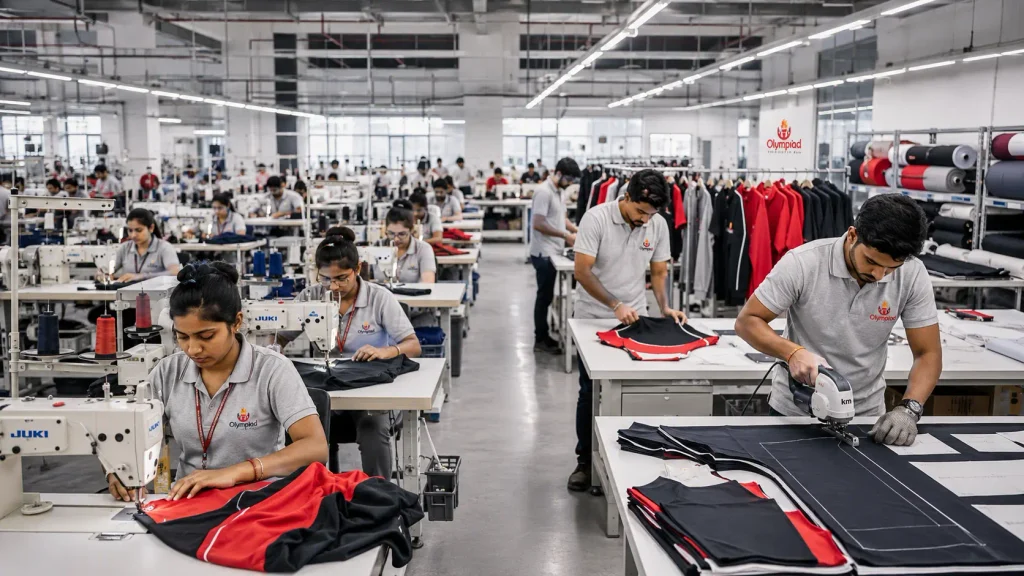
Stitching is one of the most important stages in garment manufacturing. After fabric selection, pattern development, and cutting, individual fabric panels must be joined accurately to create the final garment. The quality of stitching directly affects the strength, comfort, appearance, fitting, and durability of sportswear, activewear, streetwear, uniforms, and other apparel.
At Olympiad Industries, stitching is treated as a precision manufacturing process rather than simply joining pieces of fabric together. Different garments, fabrics, seams, and performance requirements need different machines, stitch types, thread specifications, and construction techniques. Our production team follows approved patterns and samples carefully to maintain consistency from the first piece to bulk production.
Whether we are producing custom team uniforms, performance sportswear, training apparel, activewear, streetwear, or private-label garments, our goal is to achieve strong construction, clean finishing, comfortable seams, and consistent sizing.
Why Stitching Quality Matters
Good stitching provides the structural strength of a garment. Even premium fabric and excellent printing cannot compensate for weak or poorly constructed seams.
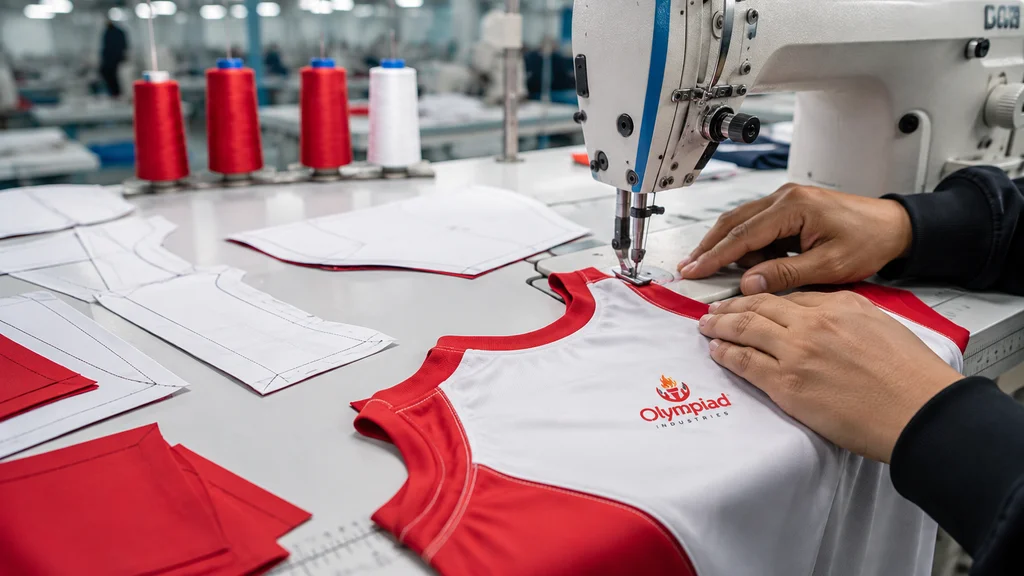
Professional stitching helps ensure:
- Strong and durable garment construction
- Accurate fitting and shape
- Comfortable movement
- Clean and professional appearance
- Strong seams in high-stress areas
- Reduced risk of seam opening
- Consistent sizing across bulk orders
- Better performance during sports and training
- Longer garment life
- High-quality finishing for retail and private-label products
For performance garments in particular, stitching must be strong enough to handle stretching, repeated movement, washing, training, and competition.
Stitching According to the Approved Pattern
The stitching process begins with accurately cut fabric panels.
Each part of the garment is prepared according to the approved pattern, including components such as:
- Front panels
- Back panels
- Sleeves
- Side panels
- Collars
- Cuffs
- Waistbands
- Pockets
- Hoods
- Plackets
- Inserts
- Ribbing
- Linings
- Reinforcement pieces
During assembly, operators follow the required seam allowances, matching points, panel positions, and garment construction sequence.
Correct alignment is especially important for custom garments because misplaced panels or uneven seams can affect the overall appearance and fit.
Selecting the Right Stitch Type
Different areas of a garment require different types of stitches.
The selected stitch depends on several factors, including:
- Fabric type
- Fabric weight
- Stretch level
- Garment style
- Seam position
- Required strength
- Desired appearance
- End-use of the garment
Using the correct stitch type helps achieve both durability and flexibility.
Lockstitch
Lockstitch is one of the most commonly used stitching methods in garment production.
It creates a clean and secure seam and can be used for many general construction operations.
Typical applications include:
- Pockets
- Labels
- Plackets
- Decorative seams
- Woven garments
- Reinforcement areas
Lockstitch provides a neat appearance and good seam stability.
Overlock Stitching
Overlock stitching is commonly used to join fabric panels while finishing raw fabric edges at the same time.
It helps prevent fabric edges from fraying and creates a clean internal finish.
Overlock stitching is widely used in:
- T-shirts
- Sports jerseys
- Tracksuits
- Hoodies
- Activewear
- Shorts
- Training wear
- Casual garments
Depending on the garment and fabric, different overlock configurations may be used.
Flatlock Stitching
Flatlock stitching is particularly useful for sportswear and activewear.
Unlike bulky traditional seams, flatlock construction creates a flatter seam profile that can help reduce irritation when the garment moves against the skin.
It is commonly used in:
- Compression wear
- Leggings
- Training tops
- Running wear
- Cycling apparel
- Gym wear
- Base layers
- Performance garments
Flatlock stitching also provides a distinctive technical appearance that is popular in modern athletic apparel.
Coverstitch
Coverstitch is commonly used for hems and stretch garments.
It allows the stitched area to maintain flexibility while creating a clean professional finish.
Common applications include:
- T-shirt hems
- Sleeve hems
- Activewear
- Sports tops
- Leggings
- Stretch garments
Coverstitching is especially useful where the fabric must stretch without breaking the seam.
Single-Needle Stitching
Single-needle machines are used for many precision stitching operations.
They are suitable for areas where accurate seam placement and clean finishing are required.
Applications can include:
- Pockets
- Labels
- Plackets
- Topstitching
- Zipper installation
- Decorative seams
- Reinforcement work
Operators carefully control stitch distance and alignment to achieve consistent results.
Double-Needle Stitching
Double-needle stitching creates two parallel rows of stitches.
It can improve strength while also creating a professional decorative finish.
It is often used on:
- Sportswear
- Casual wear
- Workwear
- T-shirts
- Jackets
- Uniforms
- Pockets
- Seams requiring extra reinforcement
The exact application depends on garment design and customer specifications.
Stitching Stretch Fabrics
Stretch fabrics require special attention during sewing.
Materials containing elastane, spandex, or other stretch fibers must be stitched in a way that allows the seam to move with the fabric.
If an unsuitable stitch or incorrect thread tension is used, several problems can occur, including:
- Broken seams
- Puckering
- Restricted stretch
- Fabric damage
- Uneven stitching
Our stitching process is adjusted according to the stretch characteristics of the selected material.
This is particularly important for leggings, compression apparel, gym wear, cycling clothing, fitted sports tops, and other performance garments.
Seam Strength for Sportswear
Sports garments experience more movement and stress than many everyday garments.
Running, jumping, stretching, tackling, lifting, and repeated body movement place pressure on seams.
For this reason, extra attention may be given to high-stress areas such as:
- Shoulders
- Armholes
- Side seams
- Crotch seams
- Waistbands
- Pocket openings
- Zipper areas
- Neck openings
Appropriate stitch construction and reinforcement help improve garment durability.
Reinforcement Stitching
Certain areas of a garment may require additional reinforcement.
Reinforcement helps prevent seams from opening or tearing when the garment is under stress.
Depending on the product, reinforcement may be used around:
- Pocket corners
- Zipper ends
- Plackets
- Waistbands
- Drawcord openings
- Shoulder areas
- Side seams
- Crotch areas
- Attachment points
The reinforcement method is selected according to the garment design and intended use.
Thread Selection
Thread quality plays an important role in garment construction.
The thread must be compatible with the fabric, stitch type, garment application, and required strength.
Important considerations include:
- Thread strength
- Thickness
- Flexibility
- Color
- Fabric compatibility
- Washing resistance
- Stretch requirements
Thread colors can also be selected to match the garment fabric or create a contrasting decorative effect.
Thread Color Matching
For professional-looking garments, thread color is normally selected to coordinate closely with the fabric.
This is particularly important for:
- Custom uniforms
- Private-label garments
- Fashion apparel
- Premium sportswear
- Brand-specific color combinations
Where contrast stitching is part of the design, carefully selected thread colors can also become a visible design feature.
Stitch Density
Stitch density refers to the number of stitches within a particular seam length.
The correct stitch density helps balance seam strength and appearance.
Stitches that are too widely spaced may reduce seam strength, while excessive stitching can sometimes damage certain fabrics.
Stitch density is therefore adjusted according to:
- Fabric construction
- Fabric weight
- Garment type
- Seam position
- Required durability
Thread Tension Control
Correct thread tension is necessary for smooth and balanced stitching.
Improper tension can cause:
- Loose stitches
- Thread breakage
- Seam puckering
- Uneven appearance
- Reduced seam strength
Machine settings are adjusted according to the fabric and stitching operation to maintain consistent seam quality.
Joining Garment Panels
Garment assembly usually follows a specific sequence.
Although the exact process differs by product, construction can include:
- Preparing individual panels
- Joining shoulder sections
- Attaching sleeves
- Closing side seams
- Installing collars or neck rib
- Attaching cuffs
- Constructing waistbands
- Installing pockets
- Adding zippers or plackets
- Finishing hems
- Adding labels and branding details
- Final reinforcement and inspection
Following the correct assembly sequence improves accuracy and production consistency.
Shoulder and Armhole Stitching
Shoulder and armhole areas are important in sportswear because they experience frequent movement.
Accurate construction helps provide:
- Better fit
- Comfortable movement
- Correct sleeve position
- Improved seam durability
Incorrect sleeve attachment can change the shape and fitting of the entire garment.
Collar and Neck Construction
Necklines and collars require accurate stitching to maintain their shape.
Depending on the design, garments may include:
- Crew necks
- V-necks
- Polo collars
- Ribbed collars
- Baseball-style necklines
- Custom sports jersey neck designs
Careful alignment helps prevent twisting, uneven stretching, or distorted neck openings.
Sleeve Construction
Sleeves must be attached correctly according to the approved pattern.
Important elements include:
- Sleeve orientation
- Sleeve length
- Armhole alignment
- Cuff position
- Seam matching
- Design panel alignment
For sublimated or color-block garments, correct sleeve positioning can also be important for maintaining the intended visual design.
Cuffs and Ribbing
Ribbed cuffs, collars, and waistbands may need controlled stretching during attachment.
Correct tension helps ensure that these components:
- Sit properly against the garment
- Maintain their shape
- Remain comfortable
- Do not become excessively loose
- Do not cause fabric gathering
The stitching method is selected according to the ribbing material and garment design.
Waistband Construction
Waistbands are a critical component of shorts, trousers, joggers, and training pants.
Depending on the product, waistbands may include:
- Elastic
- Drawcords
- Ribbing
- Internal elastic
- Custom branded elements
Accurate stitching helps distribute tension evenly around the waist.
Pocket Stitching
Pockets must be both functional and durable.
Different garments may include:
- Side pockets
- Zipper pockets
- Kangaroo pockets
- Welt pockets
- Patch pockets
- Hidden pockets
Pocket openings often experience repeated pulling and may require additional reinforcement.
Correct positioning is also important to maintain visual balance across the garment.
Zipper Installation
Zipper installation requires careful alignment.
The zipper should sit evenly without creating unwanted fabric waves or distortion.
Zippers may be used in:
- Jackets
- Tracksuits
- Hoodies
- Training tops
- Pants
- Performance outerwear
During stitching, attention is given to zipper position, seam alignment, top and bottom finishing, and smooth operation.
Hem Finishing
Hems provide the final finish at garment edges.
They may be required at:
- Sleeves
- T-shirt bottoms
- Shorts
- Trousers
- Skirts
- Performance tops
A clean hem contributes significantly to the overall appearance of a finished garment.
For stretch products, appropriate machines and stitch types are used so the hem can move with the fabric.
Stitching Sublimated Sportswear
Fully sublimated sportswear requires accurate stitching because designs may continue across different fabric panels.
After printed fabric is cut, panels must be joined carefully to maintain correct placement.
Attention may be required for:
- Side graphics
- Sleeve patterns
- Color blocks
- Shoulder designs
- Front and back alignment
Although certain continuous graphics can have natural tolerance at seams, accurate sewing helps create the most professional possible result.
Stitching Embroidered Garments
When embroidery is applied before final garment assembly, operators must ensure that embroidered panels are positioned correctly during stitching.
The embroidered area should not be unnecessarily folded, damaged, or distorted during sewing.
Special care may be required for garments with:
- Chest logos
- Sleeve embroidery
- Back embroidery
- Team badges
- Brand logos
Stitching Printed Garments
Screen printing, heat transfer, DTF, and other decorative processes can also affect the stitching sequence.
Depending on the design, decoration may be completed before or after certain garment construction stages.
Production planning ensures that printed graphics remain correctly positioned and protected during assembly.
Seam Allowance Control
Seam allowance is the amount of fabric between the stitching line and the cut edge.
Maintaining correct seam allowance is important because inconsistencies can affect:
- Garment measurements
- Fit
- Shape
- Symmetry
- Size consistency
Operators follow the pattern specifications to maintain accurate seam allowances throughout production.
Maintaining Measurement Accuracy
Stitching can influence the final measurements of a garment.
Even correctly cut panels can produce an incorrect finished size if seam allowances or assembly positions are inconsistent.
Key measurements may therefore be checked during production, including:
- Chest width
- Body length
- Sleeve length
- Shoulder width
- Waist
- Hip
- Inseam
- Outseam
These checks help maintain consistency between the approved sample and bulk order.
Preventing Seam Puckering
Seam puckering occurs when fabric gathers or wrinkles around a seam.
Possible causes include:
- Incorrect thread tension
- Unsuitable needle
- Incorrect stitch density
- Fabric feeding problems
- Thread and fabric incompatibility
Machine settings and sewing techniques are adjusted to reduce puckering and create smoother seams.
Machine Selection
Different garments cannot always be manufactured efficiently with a single type of sewing machine.
Depending on the product, production may involve:
- Single-needle lockstitch machines
- Overlock machines
- Flatlock machines
- Coverstitch machines
- Double-needle machines
- Specialized attachment machines
Using the appropriate equipment improves seam quality and production efficiency.
Needle Selection
Needles must also be selected according to the material.
The wrong needle can damage delicate or knitted fabrics or cause skipped stitches.
Needle selection may depend on:
- Fabric thickness
- Fabric construction
- Stretch level
- Thread thickness
- Sewing operation
Proper needle selection helps produce clean stitches while protecting the material.
Stitching Custom Team Uniforms
Custom team uniforms often contain multiple design elements and personalized components.
These can include:
- Player names
- Player numbers
- Team logos
- Sponsor logos
- Contrasting panels
- Custom collars
- Sleeve details
Garment components must be correctly identified and assembled so every player’s uniform matches the approved order specifications.
Stitching Activewear
Activewear needs a combination of flexibility, comfort, strength, and clean finishing.
Construction methods may be selected to reduce unnecessary seam bulk and improve movement.
Typical activewear products include:
- Leggings
- Sports bras
- Training tops
- Gym shirts
- Shorts
- Compression garments
- Workout sets
Stretch-compatible stitching is particularly important for these products.
Stitching Streetwear
Streetwear can involve both functional and decorative stitching.
Depending on the design, production may include:
- Oversized silhouettes
- Heavy fabrics
- Contrast stitching
- Decorative topstitching
- Multiple panels
- Large pockets
- Ribbed trims
The stitching process is adapted to maintain the intended shape and design character of the garment.
Stitching Hoodies and Tracksuits
Hoodies and tracksuits typically require several different stitching operations.
Construction may include:
- Joining body panels
- Sleeve attachment
- Hood construction
- Kangaroo or zipper pockets
- Ribbed cuffs
- Waistband ribbing
- Zipper installation
- Drawcord channels
- Labels
Because these garments contain several components, accurate production sequencing is essential.
Stitching Jackets
Jackets can be more complex than basic garments because they may include multiple layers and accessories.
Depending on the design, jacket construction may involve:
- Outer fabric
- Lining
- Padding
- Zippers
- Pockets
- Elastic
- Ribbing
- Collars
- Cuffs
Precise stitching ensures that all layers and components align correctly.
Stitching Kids’ Sportswear
Kids’ garments require particular attention to comfort, durability, and finishing.
Seams should be constructed cleanly to avoid unnecessary irritation.
Garment dimensions must also follow the approved size specifications to provide proper fit and ease of movement.
Sewing Operator Skills
Machine quality is important, but skilled operators are equally essential.
Experienced sewing operators understand:
- Fabric handling
- Machine control
- Seam allowance
- Stitch consistency
- Stretch control
- Panel matching
- Garment construction sequence
Their experience plays an important role in maintaining production quality.
In-Line Stitching Inspection
Quality inspection should not be limited to finished garments.
During stitching, production may be checked for issues such as:
- Skipped stitches
- Broken stitches
- Uneven seams
- Incorrect panel alignment
- Open seams
- Fabric puckering
- Incorrect measurements
- Twisted components
- Incorrect labels
- Loose threads
Finding issues during production allows corrections to be made before the garment reaches the final stage.
Trimming Loose Threads
After stitching, loose and unnecessary threads are carefully removed.
Thread trimming improves the visual appearance of garments and is an important part of professional finishing.
Operators inspect areas such as:
- Seams
- Labels
- Pockets
- Cuffs
- Collars
- Zippers
- Hems
This helps prepare garments for final inspection and packing.
Final Stitching Inspection
Once construction is complete, finished garments are inspected again.
Inspection can include:
- Seam strength
- Stitch consistency
- Garment measurements
- Left/right symmetry
- Collar alignment
- Sleeve alignment
- Pocket position
- Zipper function
- Hem quality
- Loose threads
- Overall finishing
Only after required quality checks are completed does the garment proceed to the next stage of finishing and packing.
Stitching Approved Samples Before Bulk Production
Before starting large production runs, an approved sample plays an important role in establishing the required construction standard.
The sample can confirm:
- Stitch type
- Seam position
- Garment measurements
- Collar construction
- Pocket placement
- Cuff design
- Waistband construction
- Overall fit
- Finishing standard
Once approved, the sample acts as a production reference for the bulk order.
Consistency During Bulk Production
For team and private-label orders, consistency across all pieces is essential.
The same stitching specifications, measurements, seam construction, and finishing standards should be followed throughout production.
Production supervision and inspections help minimize differences between individual garments.
Stitching for Custom & Private Label Orders
Every brand can have different construction requirements.
At Olympiad Industries, stitching specifications can be adjusted according to the approved product design and order requirements.
Custom options may include:
- Different stitch types
- Contrast stitching
- Custom seam construction
- Reinforced areas
- Special collars
- Custom cuffs
- Branded labels
- Custom pockets
- Zipper configurations
- Special trims
This allows brands to develop apparel that matches their identity and target market.
Our Stitching Process at Olympiad Industries
A typical stitching workflow may include:
- Reviewing the approved sample and specifications
- Organizing cut fabric components
- Matching panels according to size and design
- Preparing machines and threads
- Joining major garment panels
- Attaching sleeves and secondary components
- Installing collars, cuffs, pockets, waistbands, or zippers
- Completing hems and finishing seams
- Reinforcing required areas
- Conducting in-line quality checks
- Trimming loose threads
- Checking garment measurements
- Performing final stitching inspection
The exact sequence varies depending on the product.
Common Stitching Defects We Check For
During quality control, garments are inspected for common sewing problems such as:
- Broken stitches
- Skipped stitches
- Loose stitches
- Uneven seams
- Open seams
- Incorrect seam allowance
- Seam puckering
- Misaligned panels
- Twisted sleeves
- Uneven hems
- Incorrect pocket positions
- Improperly attached labels
- Untrimmed threads
Identifying and correcting these issues helps maintain consistent quality.
Stitching Quality and Garment Durability
A garment may look good when new, but true construction quality becomes more apparent after repeated wear and washing.
Strong, correctly engineered seams help garments maintain:
- Shape
- Fit
- Structural strength
- Appearance
- Comfort
This is particularly important for garments used regularly by sports teams, gyms, clubs, schools, businesses, and retail brands.
From Fabric Panels to Finished Garments
Stitching is the stage where individual pieces of fabric become a complete garment.
Every seam contributes to the product’s fit, strength, comfort, and appearance. Accurate stitching is therefore essential for producing professional sportswear and custom apparel that performs reliably in real use.
At Olympiad Industries, we combine appropriate sewing techniques, suitable machinery, skilled workmanship, careful measurements, and quality inspection to produce garments according to approved customer requirements.
From custom sports uniforms and activewear to streetwear, hoodies, jackets, and private-label apparel, our stitching process is focused on delivering clean construction, durable seams, and consistent production quality.