
Sportswear MOQ: Minimum Order Quantity, commonly shortened to MOQ, is one of the first commercial terms buyers encounter when discussing custom sportswear manufacturing. Yet it is also one of the most misunderstood.
A buyer may ask a manufacturer, “What is your MOQ?” expecting one simple number. In reality, the correct answer often depends on the product, fabric, color, printing method, branding requirements, packaging, and whether the order involves stock materials or completely custom development.
For a startup sportswear brand, MOQ directly affects how much capital must be committed before the first product is sold. For teams and clubs, it determines whether the manufacturer can economically produce the exact number of uniforms required. For retailers and distributors, MOQ influences unit cost, stock levels, shipping efficiency, and long-term purchasing strategy.
Understanding MOQ therefore helps buyers make better decisions before sampling or bulk production begins.
A well-planned order quantity can help balance:
- Product cost
- Inventory risk
- Fabric availability
- Design flexibility
- Private-label requirements
- Production efficiency
- Shipping cost
- Repeat-order planning
This guide explains how sportswear MOQ works, why manufacturers use minimum order quantities, which production factors influence MOQ, and how brands, teams, retailers, clubs, and startups can plan quantities more effectively.
What Does MOQ Mean in Sportswear Manufacturing?
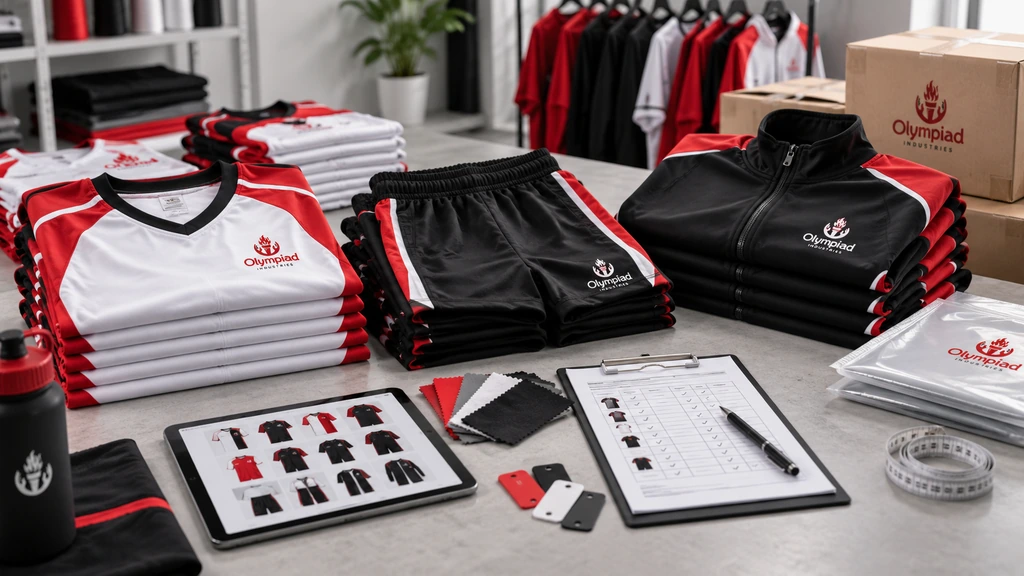
MOQ stands for Minimum Order Quantity. It represents the smallest production quantity that a manufacturer can practically or commercially accept for a particular product or production setup.
However, MOQ should not always be interpreted as one fixed number that applies to an entire factory. A manufacturer might accept one minimum for sublimated football jerseys, another for tracksuits, and a different requirement for custom-dyed activewear.
MOQ can also be affected by components outside the garment itself. A factory may be able to manufacture 50 shirts, for example, while the supplier producing custom woven labels may require 500 labels. Similarly, a custom fabric mill or packaging supplier may have its own minimum production quantity.
This is why buyers should understand what the MOQ applies to, not only the numerical quantity.
A minimum may apply to:
- One garment style
- One design
- One fabric
- One fabric color
- One decoration method
- One private-label setup
- One packaging specification
In many sportswear projects, some variation is still possible within the minimum. Buyers may be able to mix sizes, player numbers, individual names, or approved design details without creating a completely separate production run.
The most useful question to ask a manufacturer is therefore:
“How is the MOQ calculated for this specific product and specification?”
That question gives the manufacturer enough context to provide a much more accurate answer.
Why Sportswear Manufacturers Have Minimum Order Quantities
MOQ exists because custom manufacturing involves costs and preparation long before the first finished garment leaves the production line.
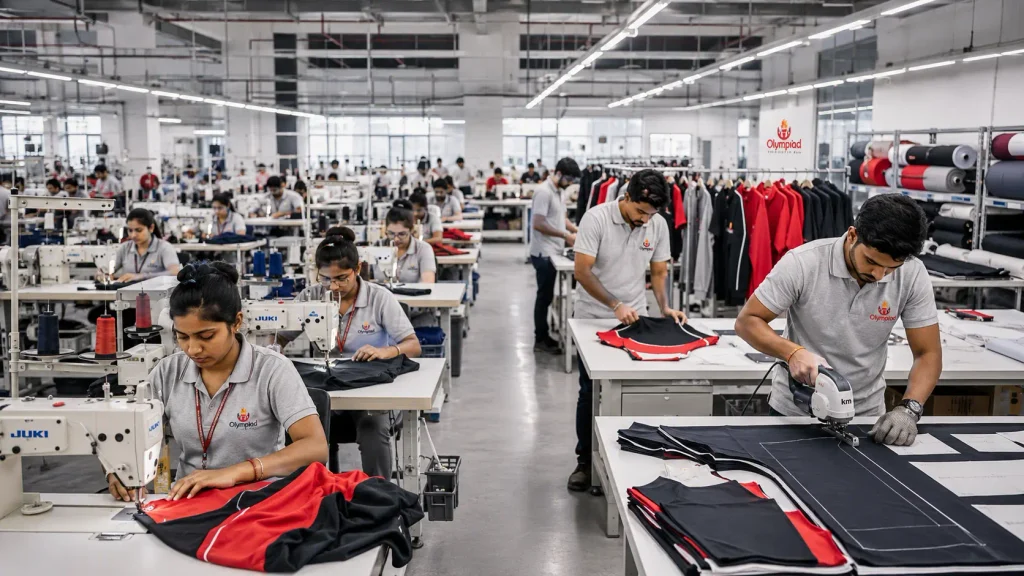
A factory does not simply pick up a blank garment and add a logo. Custom sportswear may involve product development, fabric purchasing, artwork preparation, pattern making, machine setup, cutting, stitching, quality control, packaging, and production scheduling.
Many of these activities require almost the same initial preparation whether the order is for 20 pieces or 500 pieces.
For example, a new jersey pattern may still need to be developed even if only a small quantity is ordered. Sublimation artwork still has to be prepared. Embroidery still requires digitizing. Fabric rolls still need to be sourced and handled.
That creates a minimum level at which production becomes commercially practical.
Production Setup Costs
Before production begins, manufacturers may need to complete activities such as:
- Pattern preparation
- Fabric sourcing
- Artwork setup
- Cutting planning
- Sublimation preparation
- Embroidery digitizing
- Screen preparation
- Machine setup
- Sample approval
- Quality-control preparation
These tasks create fixed or semi-fixed costs.
When more garments are produced, these costs are spread across a larger number of units.
Factory Efficiency
Factories also work more efficiently when employees and machinery can continue producing the same or similar product for a reasonable period.
Frequent changes between:
- Fabrics
- Thread colors
- Artwork
- Patterns
- Machine settings
- Labels
- Packaging
increase handling and reduce efficiency.
MOQ helps manufacturers organize production into practical batches.
Supplier Minimums
The garment factory may also depend on external suppliers for:
- Fabric
- Zippers
- Elastic
- Labels
- Hang tags
- Packaging
- Custom trims
Those suppliers may impose their own minimum quantities.
In some cases, the apparel manufacturer may be willing to produce a small order, but a particular custom component makes that quantity impractical.
Also read: How to Choose a Custom Sportswear Manufacturer for Your Team
How MOQ Is Calculated
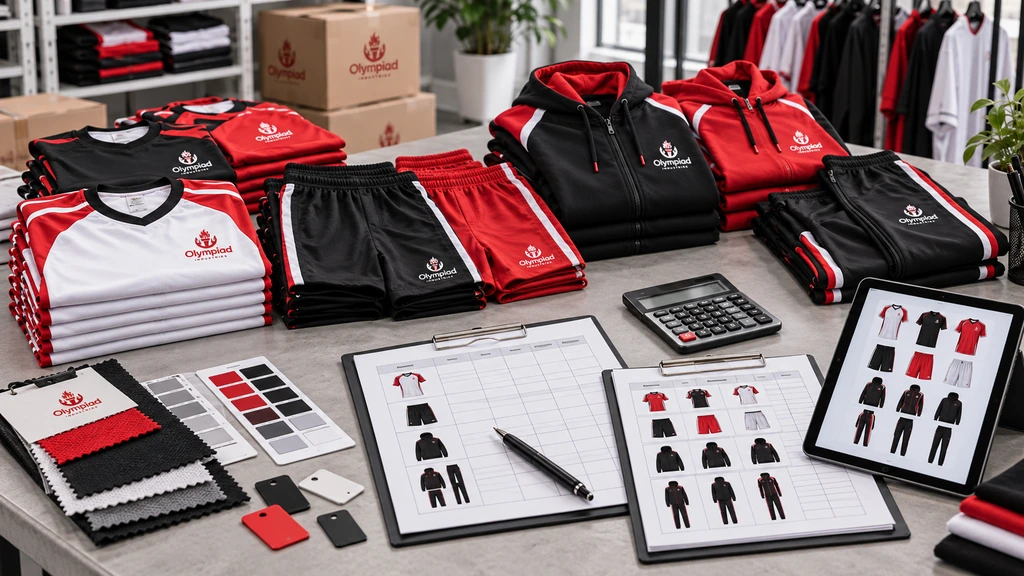
There is no universal formula for calculating sportswear MOQ. Two manufacturers producing similar products can still have different minimums because they use different equipment, suppliers, workflows, labor structures, and material sources.
MOQ is generally influenced by the amount of setup required and how efficiently the product can be manufactured.
A straightforward sublimated jersey using an available polyester fabric may allow a relatively flexible production quantity. A technical compression garment using a specially knitted stretch fabric and custom packaging may require a much larger commitment.
Common factors include:
- Product type
- Fabric availability
- Fabric composition
- GSM
- Color
- Custom dyeing
- Product complexity
- Decoration method
- Labels
- Packaging
- Quantity
- Factory schedule
Understanding these variables is important when comparing manufacturers. One supplier’s MOQ may appear higher, but the proposed specification may also involve more customization.
MOQ Per Style
Some factories establish MOQ according to each garment style.
For example:
- Football jersey
- Basketball jersey
- Hoodie
- Tracksuit
- Legging
may each be treated separately.
MOQ Per Design
Another manufacturer may allow one product type but require a minimum for each unique visual design.
If a buyer wants five unrelated jersey designs, those designs may not automatically count as one production batch.
MOQ Per Fabric
Fabric can also determine the minimum.
Several products using the same material may sometimes be easier to combine than garments requiring completely different fabrics.
Also read: Custom Sportswear Manufacturing Guide for Teams & Brands
MOQ Per Product vs MOQ Per Design
The difference between product MOQ and design MOQ is especially important for brands planning several styles.
A product MOQ normally applies to the garment category or construction. A design MOQ may apply to the individual artwork, color combination, or visual concept.
For example, a buyer might want 100 football jerseys divided into four different designs. Technically, the order contains 100 jerseys, but from a production perspective the manufacturer may have to prepare four separate artwork files, sort four designs, and manage several production variations.
Depending on the production process, the supplier might therefore treat those as four smaller runs rather than one 100-piece run.
Example
Suppose you require:
- 25 red jerseys
- 25 blue jerseys
- 25 black jerseys
- 25 white jerseys
If only the sublimated artwork changes while the pattern, fabric, and construction remain identical, a manufacturer may be able to combine them more easily.
However, if each version uses:
- Different fabrics
- Different collars
- Different panels
- Different trims
the factory may treat them as separate products.
Buyers developing a collection should clarify this before finalizing too many variations.
MOQ Per Color
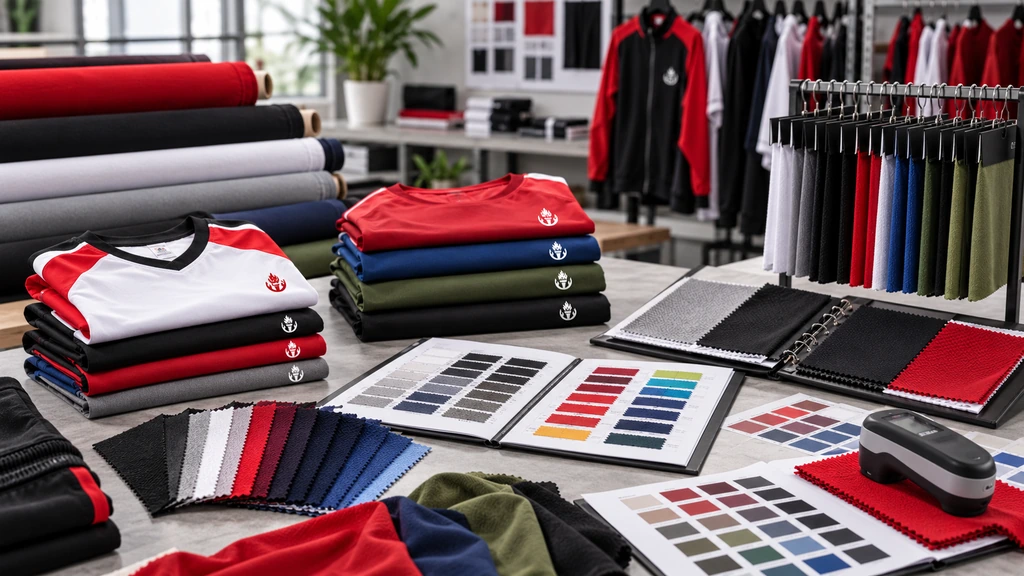
Color is one of the biggest factors affecting apparel minimums because fabric usually needs to be available in the required shade before cutting can begin.
The easiest situation is when the manufacturer already has access to the required fabric in common stock colors.
Colors such as black, white, navy, gray, and red may be easier to source in certain materials, although availability varies by supplier and season.
Stock Fabric Colors
Using available colors can help reduce:
- Fabric MOQ
- Production time
- Development cost
- Color-matching work
This makes stock colors particularly useful for startups testing a product.
Custom-Dyed Colors
Custom colors require more preparation.
The process may include:
- Providing a target color
- Producing a lab dip
- Reviewing the color
- Approving the shade
- Dyeing the production fabric
The fabric mill may require a minimum quantity before it will dye a custom batch.
This means the minimum may be driven by the fabric supplier rather than the garment manufacturer.
For established brands with strict visual standards, custom dyeing may still be worthwhile because consistent brand colors can become an important part of product identity.
MOQ Per Size
One advantage of many custom sportswear production systems is that multiple sizes can often be included within the same order.
A football team, for example, might require:
- 5 Small
- 12 Medium
- 18 Large
- 10 XL
- 5 XXL
The manufacturer will normally look at the total production quantity while managing the size breakdown during pattern grading and cutting.
However, there can still be practical restrictions.
If a buyer wants one piece in an unusual extended size, the factory may need additional pattern work or adjustments. Youth, men’s, and women’s sizing may also require different pattern sets rather than simply being treated as one size range.
For private-label brands, it is useful to ask:
- Can sizes be mixed within the MOQ?
- Is there a minimum quantity per size?
- Do extended sizes carry additional cost?
- Are men’s and women’s fits considered separate styles?
Accurate answers help prevent surprises later.
MOQ for Custom Fabrics
Custom fabric development gives brands greater control over the finished product, but it usually increases minimum quantities.
A custom sportswear fabric may involve changes to:
- Fiber composition
- GSM
- Knit construction
- Stretch percentage
- Surface texture
- Moisture management
- Color
- Brushing
- Finishing
Fabric mills operate machines designed to manufacture material in production batches. Producing a very small amount of a unique fabric can be inefficient and expensive.
For that reason, a completely new fabric may require significantly more material than an available stock fabric.
When Custom Fabric Is Worth Considering
Custom fabric can be valuable for brands that have reached enough volume to justify greater product differentiation.
It may help create:
- A distinctive hand feel
- Consistent technical performance
- Exclusive color
- Specific compression
- Premium product positioning
However, startups should carefully compare the advantages against inventory and financial risk.
A proven available fabric can often provide a better starting point for an early collection.
MOQ for Stock Fabrics
Using an available fabric is one of the most practical ways to keep initial order requirements manageable.
A manufacturer may already source certain materials regularly for existing production. If your product can use one of these materials, the factory may not need to arrange a completely new fabric production run.
Common available sportswear materials may include:
- Polyester interlock
- Bird-eye
- Mesh
- Tricot
- Fleece
- French terry
- Stretch polyester
Stock availability can change, so buyers should confirm that the chosen material will also be available for future repeat orders.
Advantages of Stock Fabric
Using available material can help reduce:
- MOQ
- Development time
- Sampling time
- Fabric cost
- Production risk
This makes stock fabrics especially suitable for:
- Startup collections
- Team uniforms
- Product testing
- Initial wholesale orders
Once demand becomes predictable, custom fabric development can be considered.
How Fabric GSM Can Affect MOQ
GSM means grams per square meter, and it indicates the weight of a fabric.
While GSM does not directly define quality, asking for a very specific weight can affect sourcing.
Suppose a manufacturer commonly works with:
- 140 GSM polyester
- 160 GSM polyester
- 180 GSM polyester
but the buyer insists on a unique 167 GSM construction.
That specific requirement may not be available as a stock fabric. The supplier could therefore need to source or develop a separate material, increasing both MOQ and lead time.
Brands should define the performance they need first and then discuss suitable fabric options with the manufacturer.
A commercially available 165 or 170 GSM fabric may provide the required performance without requiring an unnecessary custom knitting program.
MOQ for Sublimated Sportswear
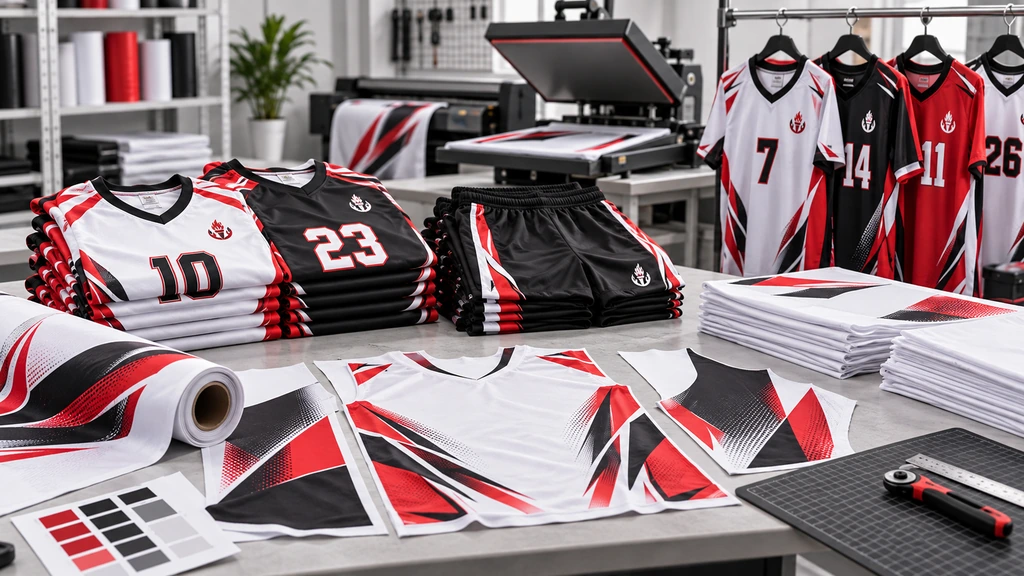
Sublimation is one of the most flexible decoration methods for custom teamwear because design changes are created digitally rather than through separate physical screens for each color.
It is commonly used for:
- Football kits
- Basketball uniforms
- Rugby kits
- Hockey jerseys
- Cycling clothing
- Training shirts
- Running apparel
The same basic jersey construction can contain different names, numbers, patterns, sponsors, and colors.
This flexibility makes sublimation particularly useful for teams.
Personalization Within One Order
A team may order one jersey design while giving every athlete:
- A different name
- A different number
- A different size
These differences can usually be built directly into the artwork.
However, sublimation does not remove all production minimums.
The factory still needs to manage:
- Fabric
- Printing
- Cutting
- Stitching
- Inspection
- Packing
MOQ therefore depends on the complete garment-production process, not printing alone.
MOQ for Embroidered Apparel
Embroidery produces a premium stitched appearance and is commonly used on heavier or more structured garments.
Typical products include:
- Polo shirts
- Jackets
- Tracksuits
- Hoodies
- Caps
Before embroidery can begin, artwork normally needs to be converted into a stitch file.
This process is known as digitizing.
The production cost can depend on:
- Logo size
- Stitch count
- Number of embroidery positions
- Quantity
- Thread colors
If the same embroidered logo is used across multiple garments, the digitizing setup can often be reused.
However, the garment itself will still have its own MOQ.
MOQ for Screen Printed Sportswear
Screen printing can be efficient for simple graphics produced in larger quantities.
Each print color may require a separate screen.
That means a one-color design requires less preparation than a complex design involving several colors.
For small quantities, these setup costs can significantly increase the price per garment.
As order quantity increases, screen preparation is spread across more pieces, making the process more economical.
MOQ therefore often depends on:
- Number of colors
- Number of print locations
- Print size
- Product
- Quantity
Brands should compare whether screen printing, sublimation, or heat transfer is most appropriate for their specific order.
MOQ for Heat Transfer Products
Heat transfer can be useful for lower-volume personalization because each transfer can be produced and applied individually.
Common applications include:
- Player names
- Numbers
- Sponsor logos
- Small graphics
- Replacement uniforms
For teams, this can make it easier to add individual player information without creating completely separate production runs.
However, heat transfer affects only the decoration stage.
The underlying jersey, jacket, or shirt may still need to meet the garment manufacturer’s production minimum.
This distinction is important when buyers assume that flexible decoration automatically means unrestricted garment quantity.
MOQ for Football and Soccer Kits
Football and soccer kits are one of the most common custom teamwear products.
A complete kit may include:
- Jersey
- Shorts
- Socks
MOQ can apply either to the jersey or to the complete set depending on the manufacturer.
Teams should also consider future needs rather than ordering exactly one piece per player.
Plan for the Entire Squad
Quantity planning should include:
- Starting players
- Reserve players
- Goalkeepers
- Coaches where required
- Future additions
Consider Spare Uniforms
Sports garments can be damaged or lost.
Keeping a small number of additional common sizes can be useful, especially if the manufacturer has a minimum requirement for repeat production.
MOQ for Basketball Uniforms
Basketball uniforms generally consist of a jersey and shorts.
Because both garments usually share coordinated artwork and fabrics, factories often handle them as complete sets.
However, teams may require:
- Home uniform
- Away uniform
- Alternate uniform
Each variation can influence MOQ.
If the construction remains the same and only sublimated graphics change, the manufacturer may offer greater flexibility.
If each version uses different materials or trims, separate minimums may apply.
Basketball buyers should therefore confirm whether MOQ applies per:
- Set
- Design
- Color
- Total order
before finalizing artwork.
MOQ for Tracksuits
Tracksuits generally require more production work than jerseys.
A full tracksuit includes:
- Jacket
- Trousers
and may also require:
- Zippers
- Pockets
- Elastic
- Drawcords
- Ribbing
- Multiple panels
- Embroidery
More components create more sourcing and assembly requirements.
For this reason, tracksuit minimums and prices may differ from lightweight jersey production.
Brands and teams looking for smaller quantities can sometimes simplify the product by using:
- Available fabric
- Standard zipper
- Existing color combinations
- Simple branding
This reduces unnecessary production complexity.
MOQ for Hoodies and Sweatshirts
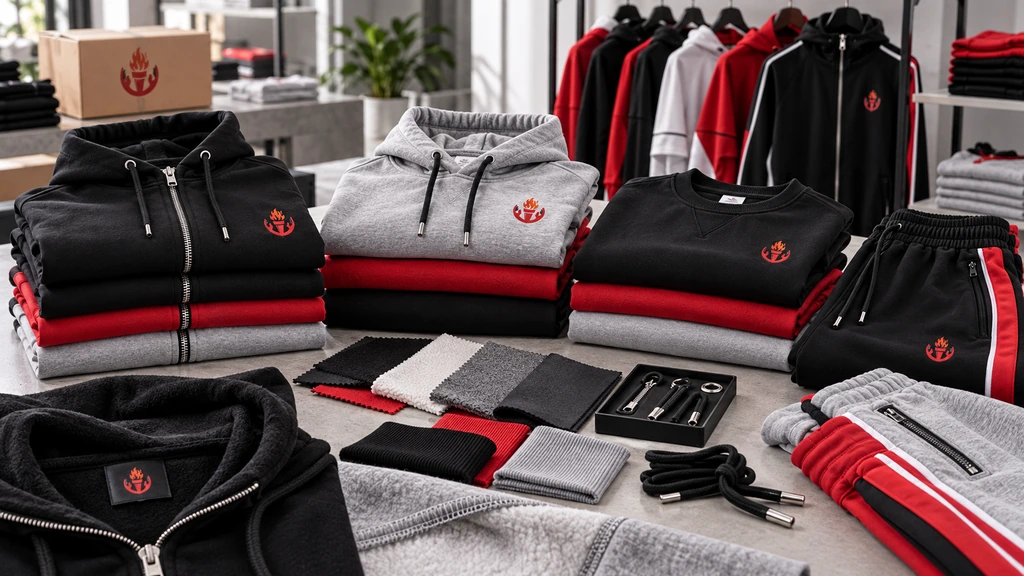
Hoodies and sweatshirts often use heavier knitted fabrics such as fleece or French terry.
Fabric requirements can become especially important because heavier material increases the total volume and cost of fabric purchasing.
A private-label hoodie may also include:
- Woven label
- Care label
- Hang tag
- Embroidery
- Custom drawcord
- Branded packaging
Each component can carry its own minimum.
Startup brands should therefore avoid looking only at the garment MOQ. The entire branding package should be reviewed together.
MOQ for Activewear and Leggings
Activewear manufacturing can involve more specialized fabrics and construction than many standard teamwear products.
Leggings, compression garments, and sports bras may require:
- High stretch
- Strong recovery
- Opacity
- Smooth surface
- Moisture management
- Flat or comfortable seams
Fabrics such as nylon-spandex and polyester-spandex can have higher sourcing requirements than common jersey polyester.
Color can also become important because stretch fabrics must maintain appearance when extended.
Before placing large activewear orders, buyers should review:
- Fabric swatches
- Stretch
- Recovery
- Opacity
- Sample fit
A technically unsuitable material can create much greater financial risk than a slightly higher MOQ.
MOQ for Private Label Sportswear
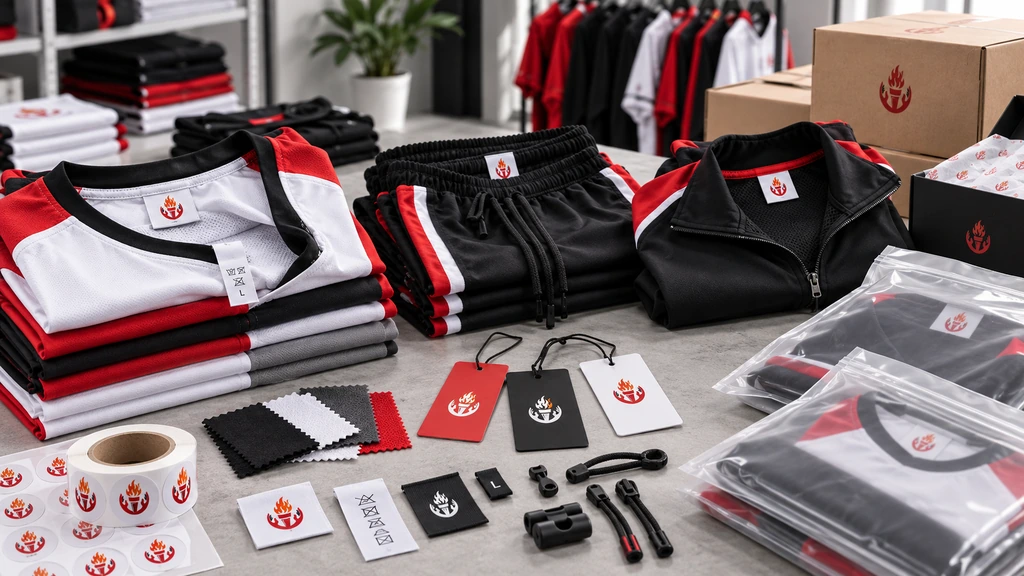
Private-label manufacturing involves building products around the buyer’s own brand rather than supplying generic apparel.
That means the production program can include:
- Custom garments
- Woven labels
- Neck labels
- Size labels
- Care labels
- Hang tags
- Packaging
A key point is that each of these items may have its own minimum.
A garment factory might accept 100 garments, while the label producer requires 500 labels.
This is not necessarily a problem.
Labels are relatively small and can often be stored for future orders.
If the brand plans repeat production, purchasing labels in larger quantities can actually reduce future setup costs.
MOQ for Custom Labels and Hang Tags
Custom labels play an important role in private-label branding.
Depending on the product, a garment may include:
- Main brand label
- Size label
- Care label
- Composition label
These components are usually manufactured separately from the garment itself.
A label supplier may require a minimum production quantity because weaving or printing also requires machine setup.
Hang tags work similarly.
Cost and MOQ may depend on:
- Tag material
- Thickness
- Shape
- Number of colors
- Printing method
- Finishing
Instead of discarding unused labels after one order, brands can often plan them for future production.
Also read: Sublimation vs Embroidery vs Screen Printing for Sportswear
MOQ for Custom Packaging
Packaging can significantly influence product presentation, but customized packaging can also create separate minimum quantities.
Possible packaging includes:
- Printed polybags
- Zip bags
- Tissue paper
- Branded boxes
- Stickers
- Custom mailers
A premium printed box may require a significantly larger minimum than a standard transparent bag.
Practical Startup Approach
A new brand does not always need expensive packaging immediately.
A professional early-stage setup might use:
- Standard protective bag
- Branded sticker
- Hang tag
- Product label
This can still create a branded experience while keeping initial costs under control.
As order volume grows, more customized packaging can be introduced.
Why Low MOQ Orders Cost More Per Piece
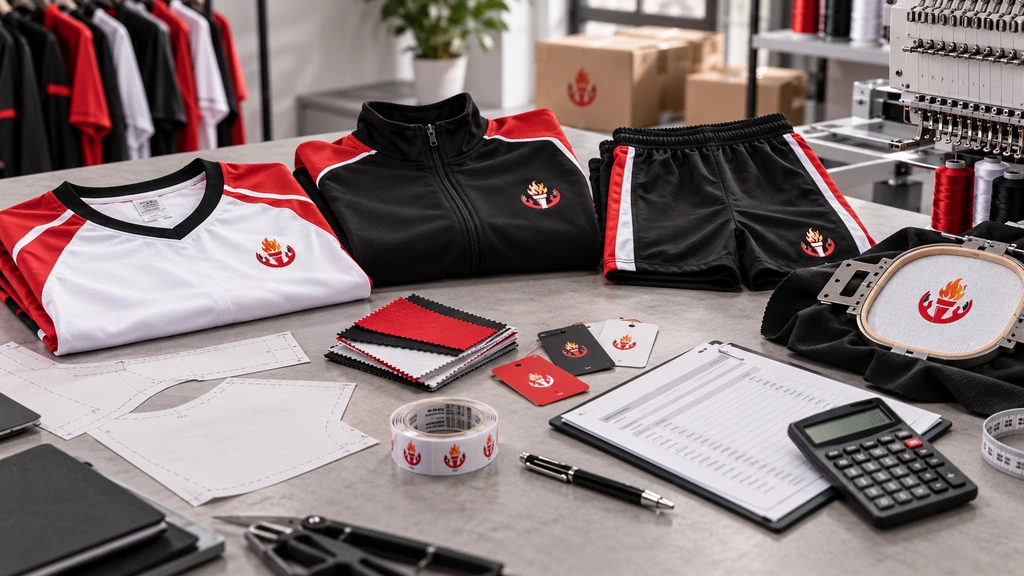
A low MOQ reduces the amount of money a buyer must invest upfront, but it usually increases unit cost.
This is because many manufacturing costs are not directly proportional to quantity.
Pattern making, sampling, artwork setup, cutting planning, digitizing, and production preparation are still required even when only a small number of garments are produced.
Suppose a production setup costs $200.
If it is spread over:
- 20 garments = $10 setup cost per garment
- 100 garments = $2 setup cost per garment
- 500 garments = $0.40 setup cost per garment
The actual manufacturing calculation is more complex, but the principle is the same.
Small orders also require more handling per unit.
This is why low MOQ and low unit price do not always occur together.
How Higher Quantities Can Reduce Unit Cost
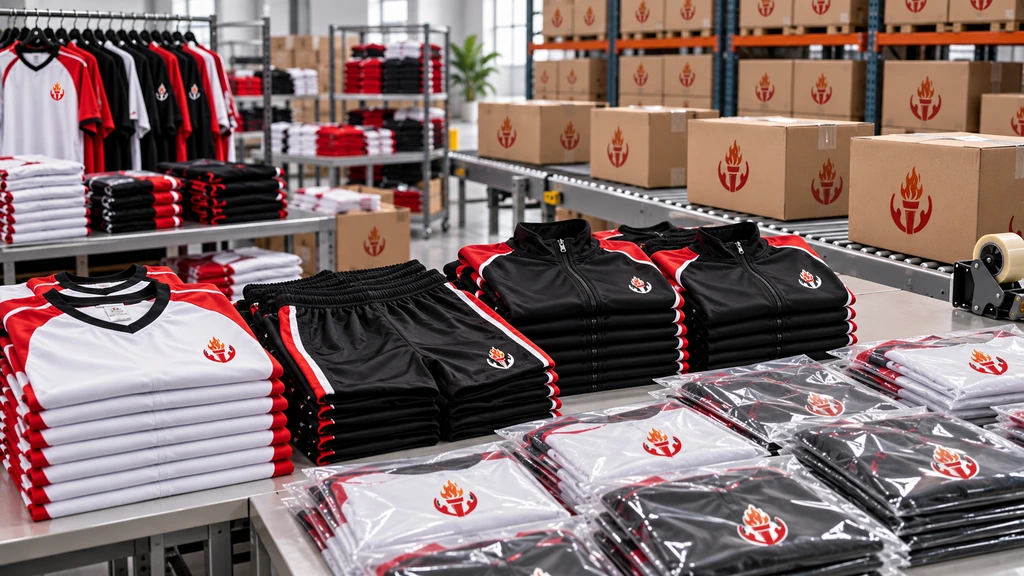
Larger quantities can create purchasing and production efficiencies.
A manufacturer may be able to:
- Purchase fabric in larger batches
- Run machines longer without changes
- Reduce setup cost per piece
- Buy trims more efficiently
- Optimize labor
These advantages can lower the unit price.
However, buyers should not assume that larger quantity is automatically the better commercial decision.
The real question is whether the inventory can be sold.
A $10 garment that remains unsold is more expensive to the business than a $12 garment that sells quickly.
Quantity decisions should therefore balance:
- Unit cost
- Demand
- Available capital
- Storage
- Cash flow
Sample Quantity vs Bulk MOQ
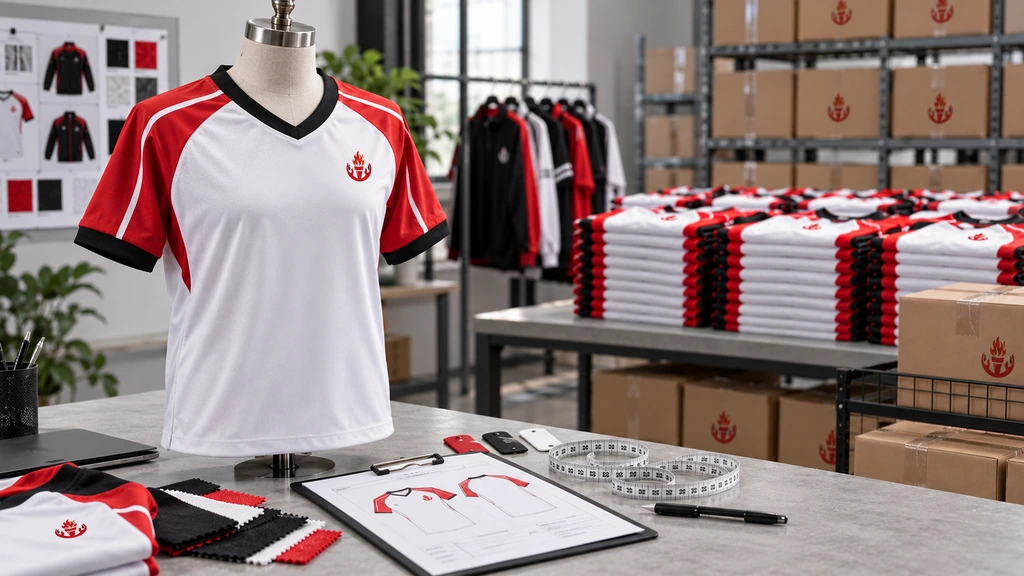
Sampling and bulk manufacturing should be treated as separate stages.
A manufacturer may produce one or two development samples even when the bulk MOQ is considerably higher.
Sampling exists to verify the product before larger production.
A sample can help confirm:
- Fabric
- GSM
- Measurements
- Fit
- Color
- Printing
- Embroidery
- Labels
- Construction
Samples usually cost significantly more per piece than the final bulk order because development work is being spread across only one or a few garments.
Buyers should therefore avoid using the sample price as an indication of normal bulk unit pricing.
Can Different Sizes Be Mixed Within an MOQ?
In many custom sportswear orders, yes.
Mixed sizes are especially common in:
- Team uniforms
- Private-label collections
- Wholesale orders
A manufacturer may accept one total quantity divided across:
- XS
- S
- M
- L
- XL
- XXL
However, the exact rules depend on the product.
A buyer should provide the size ratio as early as possible because size distribution also affects fabric consumption.
For example, an order dominated by XXL and 3XL garments will use more material than the same number of mostly Small and Medium sizes.
Also read: Best Fabrics for Sportswear: Guide for Brands & Teams
Can Different Colors Be Mixed?
Whether colors can be mixed depends largely on how the color is created.
For cut-and-sew garments using dyed fabric, every fabric color must physically be available.
This can create separate minimums.
For sublimated garments, the process is different.
The base material may be white polyester, and color is added during printing.
That can make multiple visual colorways easier to produce because the same base fabric may be used.
However, different artwork still requires planning and production management.
Buyers should confirm whether the quoted MOQ applies:
- Across all colors
- Per color
- Per artwork
Can Different Designs Be Combined?
Sometimes, but only when the manufacturing requirements are similar enough.
A manufacturer may be able to combine several designs if they all use:
- Same fabric
- Same pattern
- Same construction
- Same production process
For example, several sublimated football jersey designs may be easier to combine than unrelated garment categories.
It is much less likely that a manufacturer would consider:
- Jerseys
- Hoodies
- Leggings
- Jackets
as one MOQ because each requires different patterns, materials, machinery, and production time.
Brands should avoid assuming that “100 total pieces” automatically means 20 pieces of five unrelated products.
Also read: Private Label Sportswear Manufacturing Guide for Brands
Low MOQ vs High MOQ Manufacturing
Neither low MOQ nor high MOQ manufacturing is automatically better.
They serve different business situations.
Low MOQ
Low MOQ is often suitable for:
- Startups
- Product testing
- Small clubs
- Limited collections
- Early-stage businesses
Its main advantage is reduced financial risk.
However, buyers may receive:
- Higher unit prices
- Fewer fabric choices
- Less custom development
- Simpler packaging options
High MOQ
Higher quantities can support:
- Lower unit pricing
- Custom fabric development
- Custom colors
- More specialized trims
- Premium packaging
They are usually more appropriate for businesses with predictable demand.
The correct MOQ strategy should reflect the buyer’s current stage rather than attempting to copy a larger competitor.
Best MOQ Strategy for Startup Sportswear Brands
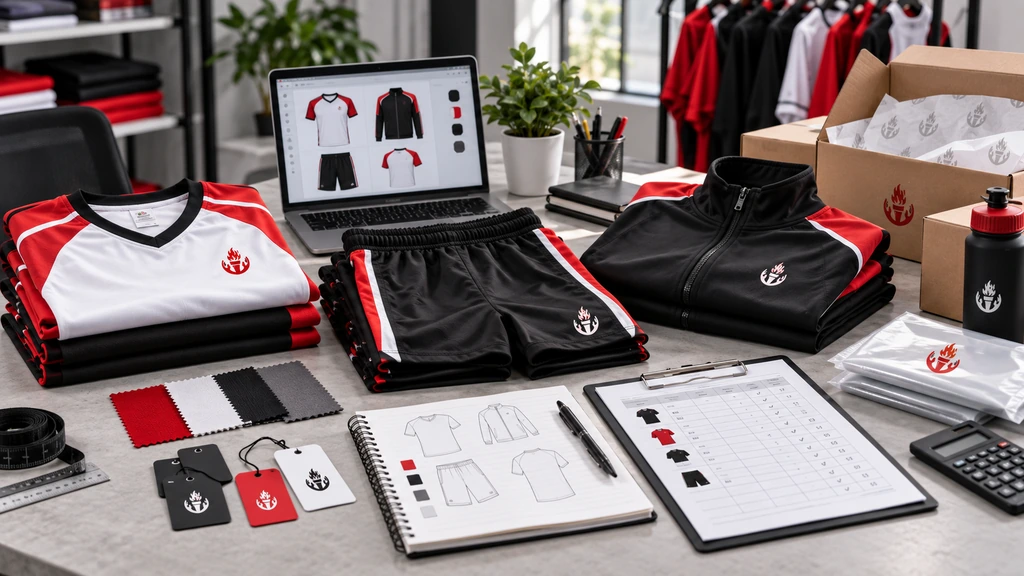
For a startup, the objective of the first production run should be to validate the business concept rather than maximize theoretical profit per unit.
New brands still need to discover:
- Best-selling products
- Popular sizes
- Strongest colors
- Effective price points
- Customer expectations
Ordering a very large quantity before learning these things can create unnecessary inventory risk.
Keep the First Collection Focused
Instead of launching 10 or 15 products, consider beginning with a smaller core range.
For example:
- Performance T-shirt
- Shorts
- Tracksuit
A focused collection allows more meaningful quantities to be allocated to each product.
Limit Color Options
A brand may initially offer:
- Black
- One signature color
instead of producing six variations.
Use Available Fabrics
Available high-quality fabrics can reduce both MOQ and development time.
Reorder Successful Products
Once demand becomes clear, repeat orders can increase quantity gradually.
This approach protects cash flow while allowing the brand to learn.
Also read: Custom Sportswear Manufacturing Cost: A Complete Pricing Guide
Best Sportswear MOQ Strategy for Teams and Clubs
Teams usually have a clearly defined customer base: their own players.
That makes quantity planning easier than retail forecasting.
However, teams should still avoid ordering exactly the number of currently registered players.
A practical calculation should consider:
- Current squad
- Goalkeepers
- Reserve players
- Coaches if needed
- Future registrations
- Replacement garments
If the squad has 25 players, ordering only 25 uniforms may create difficulties later.
A few spare pieces in common sizes can provide useful flexibility.
Teams should also ask whether small repeat orders are possible for:
- New players
- Replacement jerseys
- Size changes
This information is especially important before choosing a supplier.
Also read: Custom Team Uniforms: Guide to Design, Sizing & Ordering
Sportswear MOQ Considerations for Retailers and Distributors
Retailers and distributors generally operate at larger volumes than individual teams or startup brands.
Their challenge is not usually meeting the manufacturer’s MOQ. It is allocating inventory efficiently across:
- Products
- Sizes
- Colors
- Regions
Wholesale buyers should use sales data where available rather than distributing inventory evenly.
For example, a retailer may know that Medium and Large sell faster than XS or 3XL.
That information can be built into the production size ratio.
Distributors should also consider:
- Seasonal demand
- Shipping lead times
- Warehousing
- Repeat-production timing
Larger quantities can reduce unit cost, but poor inventory planning can eliminate those savings.
Also read: How to Choose a Sportswear Manufacturer: Guide for Brands
How to Reduce Sportswear MOQ Without Sacrificing Quality
Buyers sometimes assume the only way to reduce MOQ is to accept lower-quality manufacturing.
That is not necessarily true.
MOQ can often be reduced by simplifying the production specification rather than compromising core quality.
Use Standard High-Quality Fabrics
Choose a good available fabric rather than developing an entirely new one.
Use Existing Colors
Available fabric colors eliminate custom dyeing minimums.
Simplify Construction
Unnecessary details such as:
- Extra panels
- Decorative zippers
- Custom metal trims
can increase complexity.
Standardize Branding
Use the same:
- Main label
- Hang tag
- Packaging
across several products.
Introduce Premium Packaging Later
Start with practical branded packaging and upgrade once order volume grows.
The objective is to simplify manufacturing while preserving the product characteristics customers actually value.
How to Plan Your First Bulk Order
Planning the first bulk order requires both manufacturing knowledge and commercial judgment.
Begin by estimating realistic demand.
Consider:
- Existing customers
- Team commitments
- Pre-orders
- Social audience
- Wholesale interest
- Marketing budget
Then divide the available budget across:
- Products
- Sizes
- Colors
Avoid spreading the order too thinly across many combinations.
A collection with 3 products and 2 colors creates 6 basic product variations before sizes are even considered.
If you add 6 colors across 10 styles, inventory becomes much more complicated.
A focused first order is usually easier to market, sell, and analyze.
Also read: How to Start a Sportswear Brand: A Complete Step-by-Step Guide
Common MOQ Mistakes Buyers Make
MOQ problems often occur because buyers focus on the garment quantity while ignoring the wider production system.
Several mistakes are particularly common.
Launching Too Many Styles
Every new style can require separate:
- Patterns
- Samples
- Materials
- Production setup
A smaller, stronger collection is often more efficient.
Offering Too Many Colors
Each color divides the total order and may create additional fabric minimums.
Ignoring Supplier MOQ
The factory may accept your garment quantity while:
- Label supplier
- Fabric mill
- Packaging supplier
requires a larger production run.
Comparing Only Unit Prices
A high-quantity quotation may appear cheaper but requires more cash upfront.
Forgetting Repeat Orders
A product is easier to scale when future production can be reproduced consistently.
MOQ should therefore be evaluated as part of a long-term sourcing strategy.
Questions to Ask a Manufacturer About Sportswear MOQ
Before approving sampling or bulk production, buyers should understand exactly how the manufacturer’s quantity requirements work.
Do not rely on a general statement such as “our MOQ is 50.”
Ask how that minimum applies to your particular order.
Useful questions include:
- What is the MOQ for this specific product?
- Is MOQ calculated per style or per design?
- Can different sizes be mixed?
- Is there a minimum per size?
- Can colors be mixed?
- Is MOQ different for custom-dyed fabric?
- Can different sublimation designs be combined?
- What is the MOQ for woven labels?
- What is the MOQ for hang tags?
- Does packaging have a separate minimum?
- Is there a higher unit price below the normal MOQ?
- How does quantity affect the unit price?
- What is the MOQ for repeat production?
- Can unused labels be kept for future orders?
- Can small replacement orders be produced?
Clear answers to these questions help buyers understand the true production commitment.
How Olympiad Industries Handles Sportswear MOQ
At Olympiad Industries, custom sportswear projects can vary significantly depending on the buyer’s product, design, material, branding, and intended market.
For this reason, production quantities should be considered together with the complete specification rather than applying one universal quantity to every product category.
Projects may begin from:
- Tech packs
- Reference images
- Existing samples
- Measurement charts
- Sketches
- Artwork
- Buyer instructions
The product can then be reviewed according to its actual manufacturing requirements.
Fabric Selection
Fabric requirements can have a major influence on the practical order quantity.
Factors may include:
- Composition
- GSM
- Stretch
- Performance
- Color
- Stock availability
Where suitable, available fabrics can provide an efficient option for brands or teams beginning with smaller production quantities.
For more established programs, custom fabric development may also be considered according to project requirements.
Design Development
The design stage helps establish exactly what must be manufactured.
This may include:
- Product construction
- Panels
- Main colors
- Contrast colors
- Logo placement
- Names
- Numbers
- Decoration
A clearly approved design allows quantity planning to be aligned with the actual production process.
Sampling
Before bulk manufacturing, sample development allows buyers to review the product physically.
A sample can be assessed for:
- Fabric
- GSM
- Fit
- Measurements
- Artwork
- Stitching
- Branding
- Overall appearance
Resolving issues at this stage helps protect the larger bulk order.
Embellishment
Depending on the product, customization may include:
- Sublimation
- Embroidery
- Screen printing
- Heat transfer
Each method has different setup requirements, so decoration should be considered when planning quantities.
Private Label Development
For private-label brands, garments may also require:
- Main labels
- Size labels
- Care labels
- Hang tags
- Packaging
These components can be planned together with garment production so that unused branding materials can potentially support future repeat orders.
Bulk Production
Once the specification, sample, and order quantity are approved, the production process can move through the required manufacturing stages.
These may include:
- Material preparation
- Pattern making
- Cutting
- Stitching
- Embellishment
- Quality control
Production planning is based on the approved product rather than treating every order as identical.
Tagging and Packing
Finished garments are prepared according to the buyer’s agreed presentation requirements.
This can include:
- Brand labels
- Hang tags
- Size identification
- Individual bags
- Carton packing
The final packing structure may differ depending on whether the buyer is a team, private-label brand, retailer, distributor, or other B2B customer.
FAQs About Sportswear MOQ
What does MOQ mean in sportswear manufacturing?
MOQ means Minimum Order Quantity. It is the smallest production quantity a manufacturer can practically accept for a particular garment, fabric, design, color, or production setup.
Why do manufacturers require MOQ?
Custom manufacturing requires setup, fabric sourcing, patterns, cutting, machine preparation, labor, and sometimes minimum purchases from material suppliers. MOQ helps make those activities commercially practical.
Can I order less than a manufacturer’s MOQ?
Sometimes. A manufacturer may accept a smaller quantity with a higher unit price if materials and production conditions allow it. Other products may have firm minimum requirements because of fabric or supplier limitations.
Can I mix sizes within one sportswear MOQ?
In many cases, yes. Team and private-label orders often contain multiple sizes. Buyers should still confirm whether the manufacturer requires a minimum quantity for individual sizes.
Can different colors be combined?
Sometimes. Available stock fabrics provide more flexibility. Custom-dyed fabrics are more likely to have separate minimum requirements for each color.
Does sublimation allow lower MOQs?
Sublimation makes artwork variation and personalization easier because graphics are handled digitally. However, the garment still needs fabric, cutting, stitching, quality control, and production scheduling, so normal manufacturing minimums still apply.
Why are low-MOQ orders more expensive?
Development and setup costs are spread across fewer garments. Small runs can also require proportionally more handling and production changes, which increases the unit cost.
Do private labels have separate minimums?
Often yes. Woven labels, printed care labels, hang tags, and packaging may each be produced by specialist suppliers with their own minimum quantities.
What MOQ is best for a startup sportswear brand?
There is no single ideal quantity. A startup should balance production cost against inventory risk and expected demand. A focused initial collection using available high-quality fabrics can often be more practical than a large custom-developed range.
Can I place smaller repeat orders later?
This depends on the manufacturer, fabric availability, and product specification. Buyers should discuss repeat-order quantities before the first production run, particularly for team uniforms or products that may require replacements.
Conclusion (Sportswear MOQ)
Sportswear MOQ should not be viewed as just one number provided by a factory.
Minimum order quantity is connected to the entire manufacturing process, including fabric sourcing, colors, GSM, patterns, cutting, decoration, labels, packaging, labor, and production efficiency.
For startup brands, a lower MOQ can reduce financial and inventory risk while allowing real customer demand to be tested. The trade-off is usually a higher unit price and fewer opportunities for highly customized materials.
For established brands, retailers, and distributors, larger quantities can create better production efficiency and support custom fabric, colors, trims, and packaging.
Teams and clubs have a different challenge. Their quantities are based primarily on squad size, but they should also plan for replacement uniforms, new players, and future repeat orders.
The most important step is to understand exactly what the MOQ applies to.
Before placing an order, buyers should clarify whether the minimum applies per:
- Product
- Style
- Design
- Color
- Fabric
- Decoration method
- Branding component
A carefully planned MOQ strategy can help control investment, reduce unnecessary inventory, improve production efficiency, and create a stronger foundation for future repeat orders.
Olympiad Industries supports teams, brands, clubs, startups, retailers, distributors, and other B2B buyers with custom sportswear development, fabric selection, sampling, embellishment, private labeling, packaging, quality control, and bulk manufacturing according to buyer-specific product and quantity requirements.



Leave a Reply